

3D rendering is changing how real estate is marketed in Australia. It creates lifelike visuals of properties before construction, helping developers and agents sell faster and at higher prices. Here’s why it matters:
- Higher Sale Prices: Properties marketed with 3D visuals sell for 5–20% more.
- Faster Sales: Listings with 3D renderings sell 20–notably faster.
- Cost Savings: meaningfully reduce sales cycles and cuts marketing costs with reusable assets.
- Pre-Sales Boost: Helps sell off-plan properties early, securing funding and reducing risks.
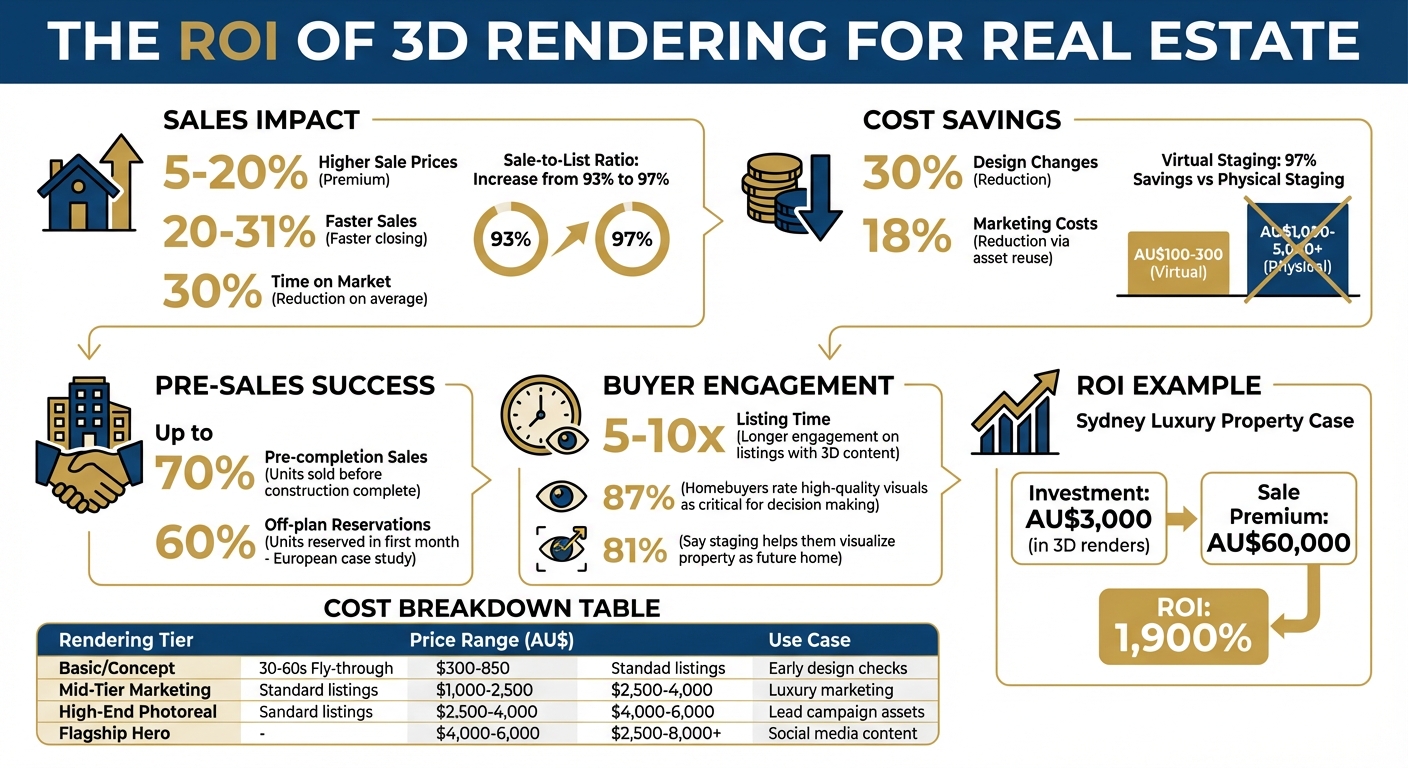
A single 3D render costs $500–$3,000, but the return can be massive. For example, spending $3,000 on renders helped a Sydney developer achieve a $60,000 sale premium - an ROI of 1,900%. Whether it’s luxury homes or off-plan units, 3D rendering is now a must-have for staying competitive in Australia’s market.
Turn Builder Blueprints into $$$ | 3D Renders & Floor Plans for Real Estate Success!
sbb-itb-1b6d2bc
What ROI Means for 3D Rendering in Real Estate
Return on investment (ROI) in 3D rendering is all about showcasing how these visual tools can drive pre-sales, elevate property value, and cut down on costly design errors before construction even begins - key advantages in today’s competitive Australian real estate market. Unlike traditional marketing expenses, which tend to be one-and-done, 3D renders are reusable assets. They can enhance investor pitches, social media campaigns, brochures, and even government permit applications.
The financial benefits of 3D rendering come from three main areas. First, increased revenue: properties marketed with 3D visuals often sell for 5–substantially more than comparable listings. Second, cost savings: there’s a 30% average reduction in design alterations and a drop in marketing expenses. Third, the time value of money: faster sales cycles mean lower holding costs, with properties selling notably faster on average. With these factors combined, it’s clear why ROI for 3D rendering is a key focus in the real estate industry.
"Most developers allocate between 0.3% and 1% of their project's GDV to CGI… That small percentage unlocks far more than just visuals - it opens doors to earlier buyer commitment and increased investor confidence".
How to Calculate ROI for 3D Rendering
The formula for calculating ROI is straightforward: ROI = [(Financial Gain – Investment Cost) / Investment Cost] × 100. Let’s look at some Australian examples to see this in action.
For a 400 sqm luxury property in Sydney, spending AU$3,000 on 3D renders as part of a AU$15,000 marketing budget resulted in an AU$60,000 premium on the sale price. That’s an ROI of 1,900%.
In Brisbane, a developer used photorealistic renders to market a three-storey family home, replacing lower-quality visuals. The property sold in just three weeks - notably faster than average - and fetched an additional AU$310,000 (an 8% premium). On top of that, the developer saved AU$2,100 in holding costs.
What 3D Rendering Costs Include
Understanding the cost breakdown for 3D rendering helps you budget effectively and negotiate smarter. In Australia, pricing usually follows this formula: hours × studio rate + assets/licences + rush fees. A typical exterior render takes 15–24 hours to complete.
The complexity of your project has the biggest impact on cost. Features like sustainable design elements, premium finishes, or unique architectural details require more time to model and render. Most studios include a limited number of revisions in their pricing, but additional changes can lead to extra fees. Urgent projects also cost more, as studios may need to allocate extra resources to meet tight deadlines. Add-ons like animations, 360-degree tours, or VR experiences will increase costs further.
Rendering service levels (Australia) Price Range (AU$) Best Use Case
Basic/Concept $300 – $850 Early design checks, DA/CDC submissions
Mid-service levels Marketing $1,000 – $2,500 Standard residential listings, brochures
High-End Photoreal $2,500 – $4,000 Luxury marketing, hoardings, print media
Flagship Hero Image $4,000 – $6,000 Lead campaign assets, high-stakes pre-sales
30–60s Fly-through $2,500 – $8,000+ Social media reels, immersive web content
To save money, provide your rendering studio with clean Revit or CAD models and a finalised material schedule. This reduces modelling time and revision cycles. Additionally, bundling multiple renders for a project can lower per-image costs by 10–25%.
Starting Metrics for Measuring ROI
Setting clear metrics before launching a 3D rendering campaign ensures you can measure its success effectively. Begin by calculating your cost per render - divide the total spend by the number of unique views each image generates. This will help identify which visuals deliver the best engagement for your investment.
Track sales velocity by comparing the time properties spend on the market when marketed with 3D renders versus traditional photography. For instance, Jay Acker from Real Estate by Design Group noted:
"We saw our average days on market drop from 30 to 21 days and our average sales price to list price jump from 93 to 97% within a six month window".
Monitor your lead conversion rate, which measures how many website visitors submit inquiries after viewing 3D tours compared to static images. Properties with 3D content often see buyers spending five to ten times longer on listings, leading to more qualified leads. Additionally, track change order frequency - 3D visualisation can meaningfully reduce sales cycles during construction.
For off-plan developments, measure the percentage of units sold before construction is halfway complete. For example, a 25-unit residential project in Europe with a €15 million GDV invested €60,000 (0.4% of GDV) in a visual service options. Within the first month of pre-sales, over 60% of the units were reserved without a physical display suite.
Measurable Benefits of 3D Rendering for Real Estate Marketing
3D rendering goes beyond just enhancing the visual appeal of real estate listings. It plays a key role in speeding up sales, cutting costs, and driving higher sale prices. The difference becomes obvious when comparing properties marketed with 3D visuals to those relying solely on traditional photography. These visuals not only attract more interest but also inspire greater buyer confidence, leading to quicker sales and better prices. Statistics reveal that properties featuring 3D visuals sell notably faster on average and achieve sale prices that are 5–markedly higher than comparable unstaged properties. Such results highlight the tangible advantages of using 3D rendering in real estate marketing.
Shorter Sales Cycles and Faster Market Entry
The amount of time a property spends on the market has a direct impact on costs, including holding costs, loan interest, and lost opportunities. Research from Kelley Anderson and K.T. Manis at Texas Tech University examined 143,575 MLS listings in four US markets. Their findings showed that listings with Matterport 3D tours closed up to notably faster and sold for 4–9% more. Similarly, real estate consultant Sebastian Diessel compared 350 properties with 3D models to 350 similar properties without them. Those with 3D models sold notably faster and commanded markedly higher prices.
In Australia, the trend holds true, particularly for off-plan developments. Developers using 3D virtual tours can pre-sell units and secure investor commitments before construction even begins. This early market entry boosts cash flow through deposits and reduces the risk of unsold inventory. For example, a developer working with ZealousXR in May 2025 used 3D interactive walkthroughs in a pre-sales campaign. This approach led to 70% of units being sold before construction was complete. Faster sales at higher prices also mean reduced marketing costs, thanks to virtual staging.
Lower Marketing Costs with Virtual Staging
Virtual staging is a game-changer when it comes to reducing marketing expenses. Traditional physical staging can cost anywhere from AU$1,000 to AU$5,000 per house, with luxury properties reaching as much as AU$30,000. In contrast, virtual staging costs around AU$100 to AU$300 per photo, offering savings of up to 97%. Additionally, 3D rendering assets are versatile and reusable, minimising the need for repeated creative work. A single 3D model can serve multiple purposes, from investor presentations and social media posts to brochures and permit applications.
In the May 2025 ZealousXR case study, the developer reduced overall marketing expenses by 18% by reusing 3D assets across various platforms. The project also saw a a substantial reduction in change orders, as 3D visuals improved communication between developers, contractors, and buyers. This combination of lower upfront costs and fewer revisions makes virtual staging an attractive option for developers managing tight budgets or large portfolios.
Better Client Engagement and Higher Conversion Rates
As costs decrease, buyer engagement tends to increase, resulting in improved conversion rates. Properties with 3D digital twins spend 20% less time on the market. This is largely because 3D rendering helps create an emotional connection - buyers can picture themselves living in the space, even before it’s built.
Metric Impact Source
Sales Price Up to a substantial increase
Time on Market Up to notably faster closing
Sale-to-List Ratio Increase from 93% to 97%
Marketing Costs ~a substantial reduction via asset reuse
Pre-completion Sales substantially of units sold
Photorealistic visuals and virtual tours eliminate much of the uncertainty buyers feel by showcasing layouts, finishes, and lighting in detail. This is particularly valuable for international buyers, who can explore properties remotely without the need for site visits. Virtual tours act as a 24/7 open house, making properties accessible to global audiences at any time. Given that online buyers often decide within 7 to 10 seconds whether a listing is worth pursuing, the first impression is critical. Moreover, a majority of buyers say staging helps them visualise a property as their future home, and 3D rendering provides this experience at a fraction of the cost of traditional staging.
Australian Case Studies: ROI Results from 3D Rendering
Examples from Australia show how 3D rendering delivers measurable benefits, helping businesses address tough market challenges.
Melbourne Warehouse Virtual Renovations
Converting heritage warehouses into modern apartments in Melbourne often comes with unique hurdles. Potential buyers can find it hard to picture how industrial spaces might transform, especially when faced with empty or outdated interiors. High-quality 3D renders make it possible for investors to visualise various layouts and finishes before construction even starts.
OBrien Real Estate in Blackburn, Melbourne, adopted Matterport 3D digital twins and virtual tours for their rental and sales listings in 2024. The impact was immediate - a 13% rise in both page views and unique visitors. Anna Molinaro, Rental Department Manager, shared:
"Matterport is a game changer for us. Clients can now envision themselves in a property before they even step through the door."
This technology also supports remote planning for unfurnished rentals. By enabling potential tenants or buyers to explore different configurations online, 3D visualisation increased interest and sped up pre-completion sales.
While heritage conversions thrive on detailed visualisation, luxury property projects face their own challenges, which 3D rendering helps overcome.
Luxury Property Marketing Success
In Australia’s luxury property market, where waterfront homes and premium urban apartments are highly desirable, 3D rendering addresses buyer hesitations about off-the-plan properties. For instance, Siera Group tackled this issue with their Tapestry Project on Chevron Island, Queensland. Principal Director Brent Thompson worked with Volume Vision to create photorealistic walkthroughs that resolved buyer concerns about unit size and view lines. Thompson noted:
"When buyers were asking the same questions about a specific unit type, Volume Vision was able to quickly create a photorealistic walkthrough of the space to help overcome queries about size and view lines, helping our team secure multiple sales."
Similarly, Amansi Group's Nineteen First Avenue project on the Gold Coast used photorealistic walkthroughs to stand out in a crowded luxury market. These visualisations showcased standout features and justified premium pricing. High-quality renders not only highlighted the finer details but also reinforced the brand’s commitment to excellence, boosting credibility in a competitive space.
Projects using immersive 3D tours reported sales cycles that were 0.3 times faster than traditional methods and a markedly higher likelihood of enquiries from buyers who interacted with the content. This is especially useful for off-the-plan purchases, where photorealistic renders replace vague architectural drawings with clear, detailed images of the final product, including landscaping and interiors. These results underline how 3D rendering accelerates sales and supports premium pricing in the property market.
How to Maximise ROI from 3D Rendering
…continued on the original article.