

Selling off-plan properties is challenging because buyers can't see or feel the finished product. 3D renders solve this by transforming technical plans into lifelike visuals, helping buyers picture the property and connect emotionally. This approach shortens sales cycles, boosts buyer confidence, and even helps developers secure financing.
Key takeaways:
- Faster sales: Virtual tours can meaningfully meaningfully reduce sales cycles.
- Buyer trust: Detailed renders eliminate uncertainty, showing everything from interiors to views.
- Marketing impact: Renders drive engagement across websites, social media, and physical display suites.
- Flexibility: Tailored visuals address buyer concerns, like room sizes or balcony views.
3D renders aren't just visuals - they're tools for building trust, driving decisions, and securing early commitments. This guide explains how to use them effectively for marketing and sales success in Australia's off-plan property market.
Benefits of 3D Renders for Off-Plan Property Sales
Helping Buyers Visualise and Connect with Properties
One of the toughest challenges in selling off-plan properties is helping buyers imagine what doesn’t yet exist. 3D renders solve this problem by turning technical plans into immersive, emotional experiences. Instead of trying to interpret lines and dimensions on paper, buyers can actually picture themselves living in the space.
These renders go beyond just showing a property - they tell a story. From showcasing sleek interiors to creating inviting outdoor scenes, they help buyers envision a lifestyle. This emotional connection often transforms casual interest into serious commitment. As Jeff Mottle, CEO and Founder of CGarchitect, explains:
"ArchViz is critical as it allows a glimpse into the future to see how the final product will come together, in its entirety."
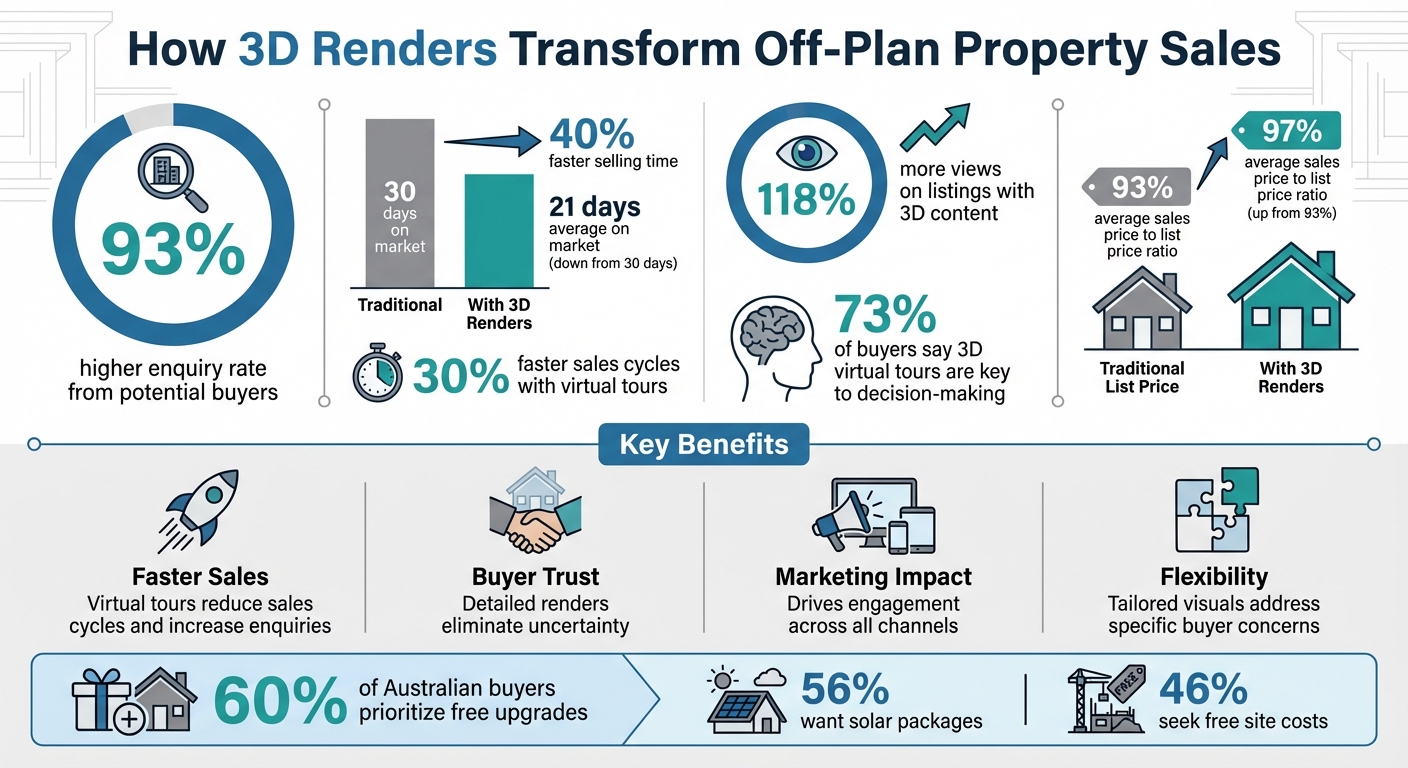
The data backs this up, too. Seventy-three per cent of buyers say 3D virtual tours are a key part of their decision-making process, and properties with immersive 3D content see a markedly higher enquiry rate from potential buyers.
Reducing Sales Cycles with Virtual Walkthroughs
Virtual walkthroughs have revolutionised the sales process, significantly speeding it up by reducing the need for multiple in-person site visits. Properties featuring immersive 3D tours report sales cycles that are notably faster than traditional approaches. The ability to explore a property remotely helps buyers make decisions more quickly, even from afar.
These walkthroughs also address specific concerns buyers often have - like room dimensions or views - helping to resolve doubts and secure commitments faster. For developers, this means not only quicker sales but also earlier access to financing. On top of that, the clarity provided by these immersive tools builds trust, as buyers can clearly see what the final product will look like.
Building Buyer Confidence in Off-Plan Purchases
Investing in a property that hasn’t been built yet can feel like a leap of faith. Traditional marketing tools like colour samples and 2D floor plans often leave buyers guessing about the final result. This is where 3D renders shine - they eliminate uncertainty by offering a complete and cohesive vision of the finished property.
High-quality renders showcase every detail, from the exact finishes and fixtures to the views from a balcony - details that are especially important to luxury property buyers. They also help buyers grasp spatial flow and scale, which are difficult to interpret from flat, 2D plans. By including surrounding streetscapes and highlighting proximity to key Australian amenities like Westfield shopping centres, schools, and public transport, renders address location concerns early on.
This level of detail directly impacts sales. As Nicole Jones, Project Marketing Director, noted:
"The 3D tours gave buyers the confidence to commit early, and the animations captured the vision better than anything we've used before."
Utilizing Real Estate Renders To Sell Developments
Working with Laurent Visuals to Create 3D Renders
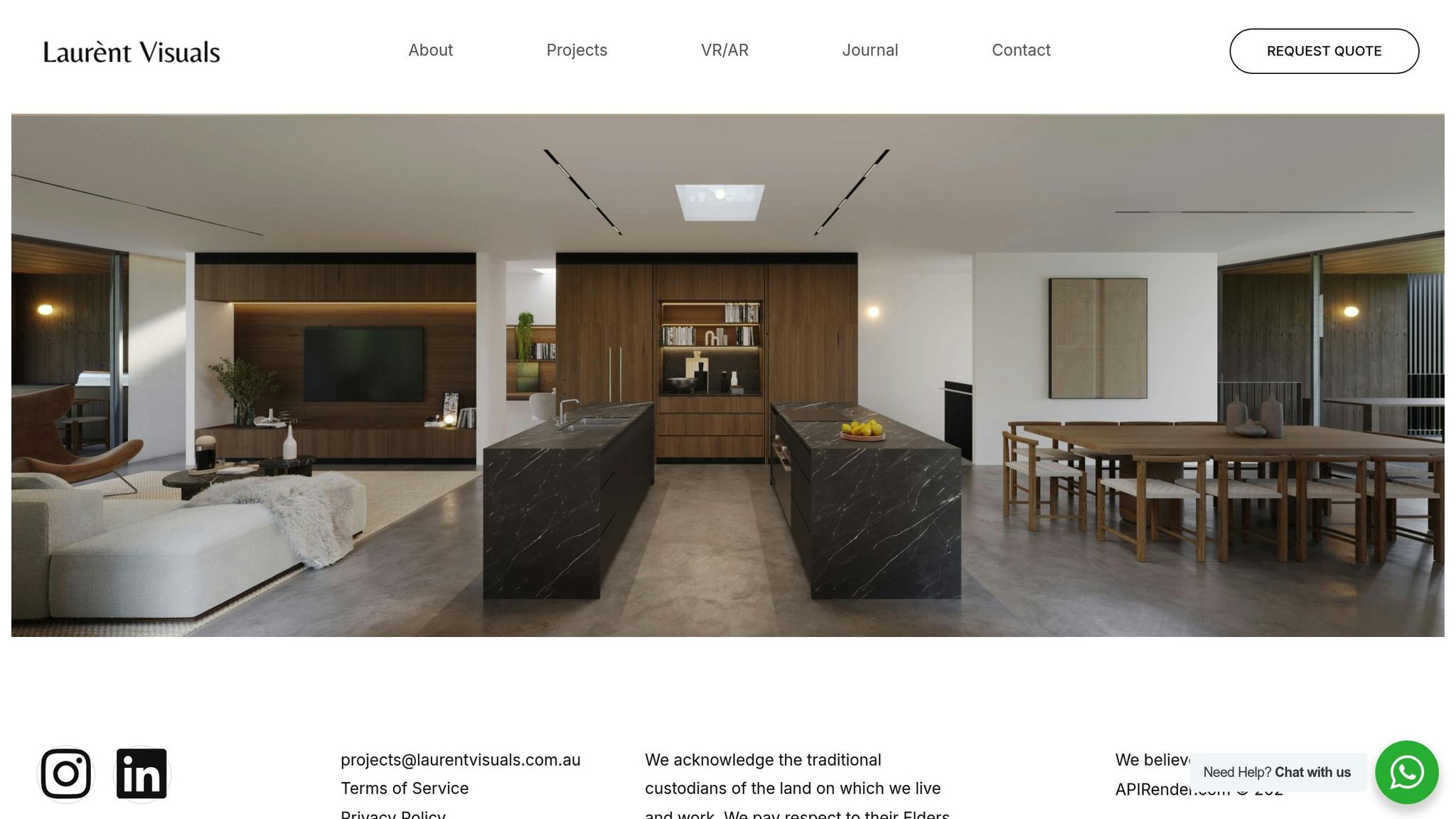
Collaborating with Laurent Visuals can turn your technical plans into captivating visuals that help speed up sales.
Step 1: Preparing Your Project Brief
Start with a detailed project brief. Share accurate 2D or 3D files (such as PDF, JPG, PNG, DWG, CAD, or BIM) that include essential design details - like colours, textures, and finishes - to clearly convey your vision. Think about your audience. For instance, are you targeting downsizers looking at luxury apartments in Toorak or young families interested in homes in Parramatta? This context helps shape the visualisation style to suit your market.
It’s also important to include site context. Provide a site plan, landscaping details, and the project address so the renders can incorporate realistic surroundings, such as neighbouring buildings or landmarks. Be clear about technical requirements, like resolution, aspect ratio, camera angles, and the mood or time of day you’re aiming for - whether that’s a twilight glow or a bright midday scene. Turnaround is generally two weeks, but urgent projects can sometimes be completed in a week.
A well-prepared brief sets the foundation for choosing the right rendering service to bring your project to life.
Step 2: Choosing the Right Rendering Services
Laurent Visuals offers a range of services, including photorealistic exterior renders, interior visualisations, virtual walkthroughs, 3D floor plans, and aerial views. Each option serves a unique purpose.
Photorealistic exterior renders are perfect for marketing hero images, showcasing façade details, lighting, and the surrounding area. Interior visualisations focus on creating emotional appeal by highlighting textures, materials, and stylish furnishings. For buyers who can’t visit in person - often the case with interstate or remote clients in Australia - virtual walkthroughs offer an immersive experience, letting them explore the property as if they were there. Additionally, 3D floor plans can help those who struggle with traditional blueprints, while aerial renders are ideal for highlighting proximity to key amenities like schools, shopping centres, or public transport.
Different projects call for different approaches. Luxury developments might emphasise mood and elegance, while suburban projects often focus on practicality and lifestyle. As Tim Brickle from 3D Walkabout explains:
"3D renders are the backbone of your marketing. They'll be the focal point of your brochures, your website and your social channels. They are what grabs attention, because no one is going to click on a floor plan."
To get started, a 50% deposit is usually required, with the remaining balance due once you’ve reviewed the watermarked final drafts. Pricing typically starts at a few hundred dollars, depending on the project’s size and complexity.
Once the initial renders are ready, the next step is refining them through feedback.
Step 3: Reviewing Previews and Giving Feedback
Reviewing previews is crucial to ensure the designs are accurate and meet your expectations. The process often begins with an initial 3D model that confirms the structure and geometry before adding textures, materials, and lighting. This step helps catch issues early, like unwanted shadows on neighbouring properties or adjustments needed for rooflines.
When reviewing, pay attention to materials, scale, lighting, and how the render integrates with its surroundings. Be specific with your feedback. For example, instead of saying, "the façade doesn’t look right", try something more precise like, "could we change the roof colour to Colorbond Monument and add two extra windows on the eastern elevation?" High-quality renders act as a universal language, making it easier for stakeholders like council planners or investors to visualise and approve the design.
Virtual walkthroughs can also be helpful during this stage, as they reveal flow issues that static images might not capture. This gives you the chance to address potential problems before finalising the design. A thorough review not only perfects the visuals but also builds buyer confidence, especially for off-plan purchases.
sbb-itb-1b6d2bc
Using 3D Renders in Your Marketing Campaigns
Once you've finalised your 3D renders, the next step is putting them to work in your marketing campaigns. These visuals can seamlessly integrate into your existing strategies, helping you engage potential buyers and achieve measurable results.
Distributing Renders Across Multiple Channels
Your 3D renders should take centre stage across all your marketing efforts. Start by creating a dedicated project website that features your renders, detailed floor plans, and a sign-up form for interested buyers. Use social media platforms like Facebook and Instagram to run targeted campaigns that introduce your property to key demographics before it officially hits the market. Tailor your ads by location and property type to maximise their reach.
For luxury developments, physical display suites can make a big impact. Equip them with touch screens, tablets, or VR headsets like Oculus to offer virtual tours. You can also run guided 3D animations on showroom screens to provide a continuous visual experience. High-resolution renders are ideal for printed brochures and large-scale site hoardings - just ensure the files meet the correct specifications for both digital and print formats. Keep in mind that substantially of homebuyers considering new properties are also looking at existing homes, so your visuals need to compete with the quality of real photography.
A great example of this approach is Siera Group's collaboration with Volume Vision in June 2023 to market Tapestry, a 22-storey development on Chevron Island. By using photorealistic walkthroughs to address buyer concerns about unit sizes and view lines, they managed to sell multiple units that are typically harder to move. As Brent Thompson, Siera Group's Principal Director, explained:
"When buyers were asking the same questions about a specific unit type, Volume Vision was able to quickly create a photorealistic walkthrough of the space to help overcome queries about size and view lines, helping our team secure multiple sales."
Adding Virtual Walkthroughs for Interactive Experiences
Static images are great, but interactive experiences take buyer engagement to the next level. Virtual walkthroughs let potential buyers explore properties at their own pace, making them especially valuable for interstate or remote clients. Whether you choose guided animations or 360-degree tours, these tools create a more immersive experience.
The results speak for themselves: listings with immersive media see a markedly higher likelihood of enquiry and help shorten sales cycles. Feature these walkthroughs prominently on your project website and share them through email campaigns targeting registered buyers. In physical showrooms, VR headsets can provide an even deeper level of interaction during sales presentations. And thanks to web-based technology, sales teams can now showcase photorealistic walkthroughs on any device, eliminating the need for costly physical setups.
Tailoring Content for Australian Buyers
When marketing to Australian buyers, it’s essential to focus on storytelling that reflects their lifestyle. Your renders should include relatable details like a BBQ on the back deck, a family SUV in the garage, or Nordic-inspired interiors that align with local design preferences. Highlight the surrounding neighbourhood too - proximity to places like Westfield, train stations, or local parks can help buyers picture the lifestyle your property offers.
For owner-occupiers, showcase modern features and customisation options. Investors, on the other hand, are often more interested in financial benefits and the timeframe for settlement. Research shows that 60% of Australian buyers are drawn to free upgrades, with 56% prioritising solar service options and 46% looking for free site costs. Use your renders to highlight standout features like rooftop pools, gyms, or eco-friendly designs to cater to these preferences.
Accuracy is key. Avoid repetitive textures, ensure furniture and power points are to scale, and use depth of field to give your renders a polished, professional look. Even minor inconsistencies can undermine buyer confidence. For exterior shots, consider rendering them at twilight or dusk to create a warm, inviting atmosphere that draws people in.
Tracking Results and Improving Your Approach
Once your 3D renders are woven into your marketing campaigns, the next step is to measure their impact and fine-tune your approach based on the data. This shifts your efforts from guesswork to a data-driven strategy, helping you see where your investment is yielding results and where adjustments are needed.
Measuring Sales Performance with Key Metrics
…continued on the original article.