
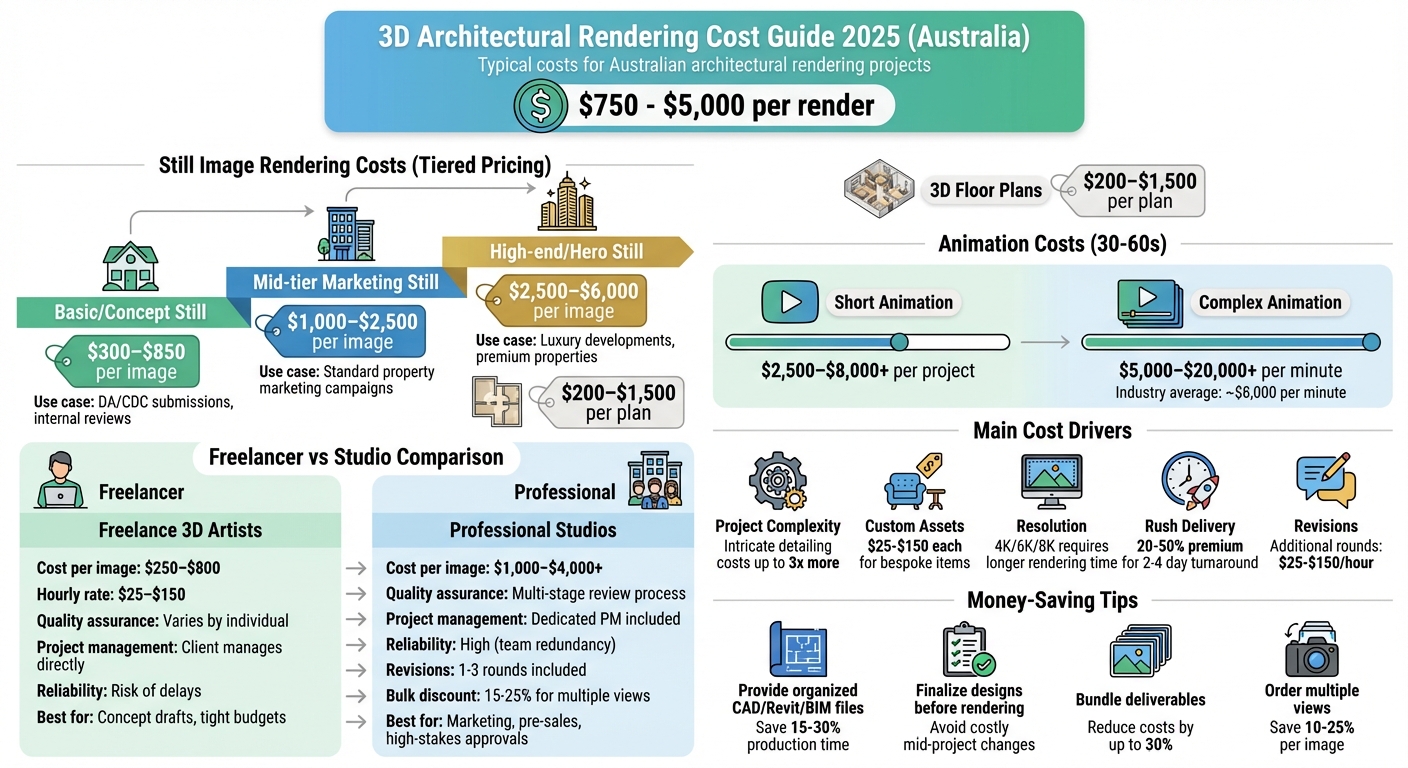
3D architectural rendering is now an essential part of property development and marketing in Australia. Costs vary widely, ranging from $750 to $5,000 per render, depending on factors like project complexity, deliverables, and timelines. Here's what you need to know to budget effectively:
- Main Cost Drivers: Complexity, custom assets, resolution, and tight deadlines.
- Typical Costs: Basic renders start at $300, mid-service levels marketing visuals cost $1,000–$2,500, and high-end images can exceed $6,000.
- Animation Costs: Short walkthroughs range from $2,500–$8,000+, while advanced animations can cost $5,000–$20,000+ per minute.
- Saving Tips: Provide organised files, finalise designs early, and bundle deliverables to meaningfully reduce sales cycles.
- Freelancer vs Studio: Freelancers charge $250–$800 per image, while studios offer reliability and quality at $1,000–$4,000+ per image.
Key takeaway: Plan ahead, prioritise your needs, and match render quality to your project goals to avoid overspending.
How To Price 3D Rendering (Masterclass)
Main Cost Factors for 3D Rendering Projects
Knowing what drives the costs of 3D rendering can help you plan your budget effectively and steer clear of unexpected expenses. The main factors influencing your costs are the complexity of your project, the type of deliverables you require, and the timeline for delivery.
Project Complexity and Scope
The level of detail and architectural style of your project play a big role in determining costs. For instance, a classic interior with intricate detailing can cost up to three times more than a modern interior of the same size. Features like curved forms, decorative façades, and unique architectural elements demand significantly more modelling time compared to simpler geometric designs.
Custom assets also add to the expense. Bespoke items such as furniture, specific plant species, or branded fixtures can cost anywhere between $25 and $150 each. If your project includes detailed surroundings - like nearby buildings, uneven terrain, or dense vegetation - especially for exterior or aerial views, expect additional charges.
Realistic materials further impact costs. Complex materials, such as reflective surfaces, transparent glass, or layered textures, require advanced skills and more rendering power. This is especially true when paired with sophisticated lighting setups, like dusk scenes or global illumination. However, ordering multiple views of the same project can save money, with per-image rates often reduced by 10–25% due to the reuse of the base 3D model.
Providing organised files, such as CAD, Revit, or BIM models, can save 15–30% of production time. As Cad Crowd puts it:
"An architectural rendering only has to do one job: make the otherwise conceptual idea look like a tangible final product".
Rendering Types and Deliverables
The type of deliverables you need has a direct impact on your budget. Still images are typically priced per view, while animations are charged based on duration since they require frame-by-frame rendering, which uses significant computing power. For example, architectural animations often cost around $8,000 per minute, while 3D animations in 2025 can range from $25 to $500 per second, depending on complexity.
Resolution is another cost driver. Higher resolutions, such as 4K, 6K, or 8K, require longer rendering times and more post-production work compared to standard 2K outputs. It’s wise to choose resolution based on the intended use: 2K for web approvals, 4K for hero images, and 6K or 8K for large-format prints or billboards.
Rendering Type Typical Cost (AUD) Pricing Unit
Basic/Concept Still $300–$850 Per image
Mid-service levels Marketing Still $1,000–$2,500 Per image
High-end/Hero Still $2,500–$6,000 Per image
3D Floor Plans $200–$1,500 Per plan
Short Animation (30-60s) $2,500–$8,000+ Per project
Complex Animation $5,000–$20,000+ Per minute
Interactive 3D options, like VR or AR tours, often require specialised workflows and extra testing, which can push up costs. To manage your budget, it’s smart to start with a "must-have" list of views rather than a long wish list.
Timeline Requirements and Revision Cycles
Tight deadlines can significantly raise costs. Rush delivery - turnarounds within 2 to 4 days, or even under 48 to 72 hours - can add a premium of 20–50% to standard rates. Meeting such deadlines often requires studios to assign extra artists, work overtime, or use external render farms.
For a standard project, rendering usually takes 1 to 3 weeks, with about 5–10 business days allocated per image. Most studios include 1 to 3 revision rounds in their base pricing, with additional rounds charged hourly at rates ranging from $25 to $150.
Late-stage design changes - like altering layouts or lighting concepts - can lead to major rework and higher costs, unlike minor tweaks that are less disruptive. Finalising key elements like architectural designs, materials, and lighting before rendering starts can help avoid costly revisions. Additionally, consolidating feedback into clear, organised notes during each revision round is crucial to keeping the process efficient and cost-effective.
Typical 3D Rendering Costs in Australia (AUD)
Understanding 3D rendering costs is essential for setting a realistic budget. Prices can vary greatly depending on the location. For instance, Sydney and Melbourne tend to have higher rates due to elevated commercial rents and operating costs, whereas Brisbane-based providers often offer more competitive pricing.
Australian studios generally charge per image, basing their quotes on the estimated time and a standard studio day rate. The industry typically operates within three pricing categories: basic concept work for early-stage design checks, mid-service levels marketing images for standard campaigns, and high-end photorealistic "hero" images for premium properties. On average, mid-service levels marketing images cost around $1,500 each. Let’s break down the costs further, starting with exterior rendering.
Exterior Rendering Costs
The cost of exterior renders depends on factors like building size, architectural complexity, and the level of detail required for the surroundings. For basic concept renders - suitable for Development Application (DA) or Complying Development Certificate (CDC) submissions - prices range from $300 to $850. These images focus on providing contextual views without the refinement needed for marketing purposes.
For residential marketing, mid-service levels quality renders cost between $1,000 and $2,500 per image, offering a polished look that highlights the property. High-end renders for luxury developments, featuring intricate lighting and landscaping, can range from $2,500 to $6,000 per image. Commercial exteriors tend to be pricier: large-scale projects with detailed streetscapes typically cost $900 to $3,000, while highly complex designs can exceed $10,000.
When planning a duplex marketing service options in New South Wales, expect to spend $5,000 to $15,000 for 4–6 images. This usually includes one hero exterior image, a secondary angle, and 2–4 interior renders. For townhouse developments requiring 5–7 images, budgets range from $7,000 to $18,000. These figures provide a framework for tackling projects of varying scales.
Interior Rendering Costs
Interior renders follow a different pricing structure. For residential interiors with basic detailing, concept-level renders cost between $300 and $800. Mid-service levels marketing-quality renders fall in the $1,000 to $2,500 range. High-end residential interiors, which often feature premium finishes and detailed furnishings, can cost anywhere from $2,000 to $5,000.
Commercial interiors, due to their complexity and customisation needs, are more expensive. Basic commercial interior renders range from $450 to $1,500. Mid-service levels commercial projects cost $2,500 to $5,000 per image, while premium renders for high-end spaces can exceed $5,000.
As Nathan Battishall explains:
"3D architectural rendering cost is driven by time and expertise. More hours and higher-calibre talent equal higher fees".
Animation and Walkthrough Costs
If you’re looking for more dynamic visuals, animations and walkthroughs come with their own pricing models. Animations require frame-by-frame rendering, often combined with sound design and cinematic editing. A short 30–60 second fly-through costs between $2,500 and $8,000+, while more complex animations with detailed scenes and advanced post-production range from $5,000 to $15,000+.
The industry average for animations in Australia is approximately $8,000 per minute of finished footage. For 360° virtual tours, prices start at $350 per panorama or node, scaling up to $2,000 to $8,000 for advanced virtual reality (VR) experiences. Fully immersive VR service options, which include multiple interactive rooms, can cost between $15,000 and $50,000.
Software and Hardware Costs for In-House Rendering
Setting up an in-house rendering system requires a hefty initial investment and ongoing expenses for software and high-performance hardware. The key to success lies in balancing these costs to meet rendering demands efficiently.
Software Licensing Fees
Professional 3D rendering relies heavily on two types of software: BIM/modelling tools (like Revit, ArchiCAD, SketchUp, and Rhino) and rendering engines (such as Enscape, V-Ray, Lumion, and 3ds Max). For example, Autodesk Revit, a popular tool for multidisciplinary coordination and automated documentation in Australia, comes with an annual subscription of A$4,585. Rendering engines vary in cost: Enscape is A$961.70 annually, V-Ray costs A$810.91 per year, and Lumion Pro, known for its speed in architectural visuals, is priced at A$1,783.12 annually.
Real-time rendering tools like Enscape and Lumion are gaining traction for quick design reviews and client presentations directly within BIM software. Rhino 3D offers a one-time perpetual license for A$1,514.89, which can be a predictable long-term option. For those looking to save on licensing, Blender stands out as a professional-grade, free alternative, providing a complete VFX and rendering pipeline at no cost.
Some Australian firms manage software expenses through financing options. For instance, Revit’s A$4,585 annual fee can be spread out to approximately A$213.34 per month over two years.
Hardware Requirements and Upgrades
To complement the software, robust hardware is essential for smooth rendering workflows. At a minimum, professional rendering requires a CPU with speeds above 3.5 GHz, a GPU with at least 8 GB of VRAM, 32 GB of RAM, and 1 TB of NVMe SSD storage.
"32 GB RAM is a modern baseline for architecture and rendering. If your scenes carry large assets or linked models, 64 GB provides long-term stability" – Danoe Santoso, Interscale
For more demanding visualisation tasks, higher specifications are recommended. This includes processors like the Intel Core i9 or AMD Ryzen 9, GPUs such as the NVIDIA RTX A4500 or higher (with at least 16 GB of VRAM), and a minimum of 64 GB of RAM. Advanced systems also benefit from effective cooling solutions to prevent performance dips during extended rendering sessions. GPUs equipped with tensor cores (e.g., NVIDIA RTX Ada series) are particularly useful for AI-assisted rendering and denoising.
To optimise performance, it’s important to address specific bottlenecks. For instance, if your viewport stutters, upgrading the GPU might be necessary, while slow rendering times often indicate a need for a better CPU.
Beyond the initial hardware and software outlay, firms should plan for ongoing costs. These might include external render farm services during peak demand, hosting fees for 360-degree panoramas or VR tours, and periodic hardware upgrades. Many companies are also turning to Device-as-a-Service models, which bundle hardware and software into a single subscription to avoid the risk of outdated technology.
sbb-itb-1b6d2bc
Freelance versus Studio Pricing
Choosing between hiring a freelance 3D artist or partnering with a professional studio often comes down to weighing cost against reliability, quality, and the scale of your project. To budget effectively in 2025, it's important to understand how these pricing models differ. Below is a breakdown to help you decide which option suits your needs.
Freelance Pricing: Benefits and Risks
Freelancers typically charge between A$25–A$150 per hour or around A$250–A$800 per image, depending on their expertise and location. Their lower costs make them a great option for projects like early-stage concept reviews or internal design checks where achieving photorealistic results isn’t critical.
…continued on the original article.