

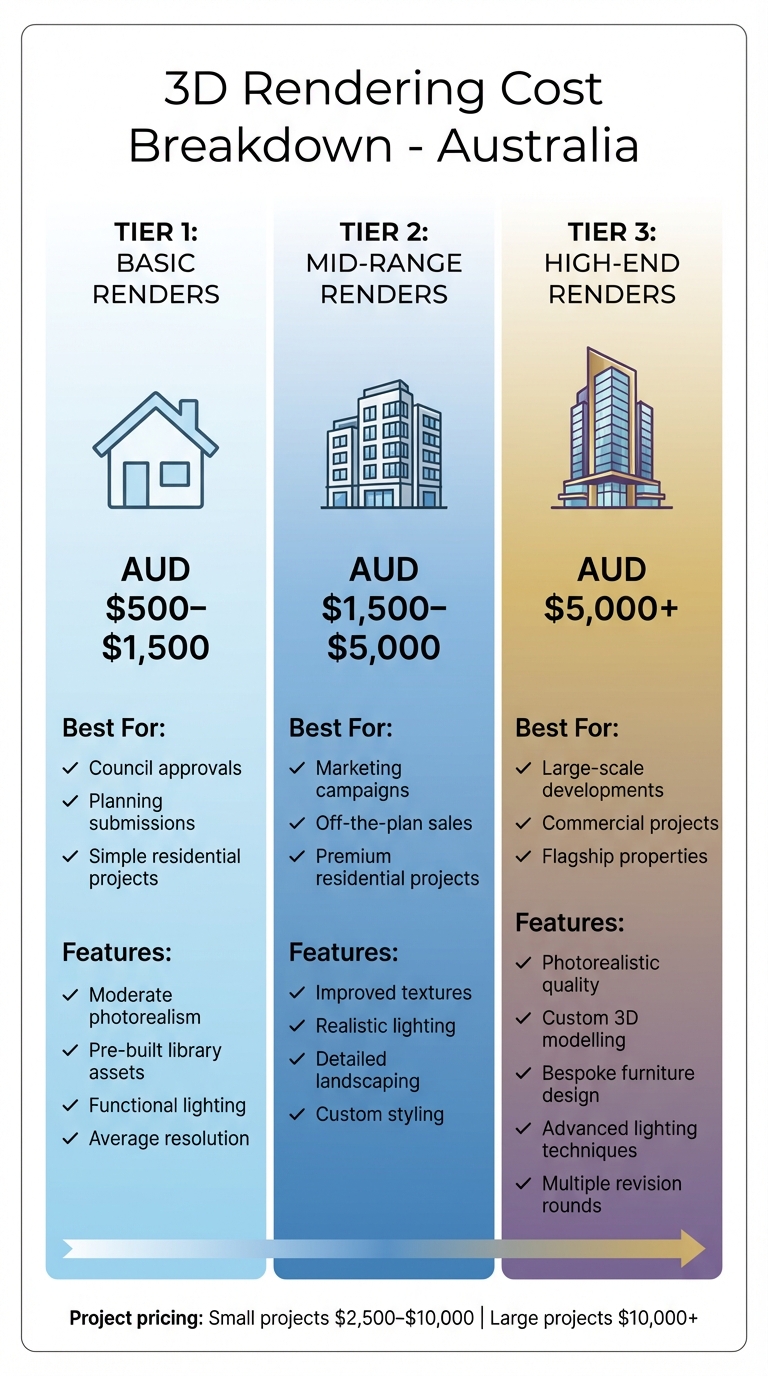
3D rendering costs in Australia vary widely, depending on the complexity of the project, the level of detail required, and delivery timelines. Here’s a quick breakdown:
- Per Image Prices:
Basic renders: AUD $500–$1,500 (suitable for council approvals or simple visuals).
- Mid-range renders: AUD $1,500–$5,000 (ideal for marketing or off-the-plan sales).
- High-end renders: AUD $5,000+ (used for large-scale developments or high-quality marketing).
Per Project Prices:
- Small projects: AUD $2,500–$10,000 (e.g., residential homes or duplexes).
- Large projects: AUD $10,000+ (e.g., apartment complexes or commercial buildings).
Key factors influencing costs include:
- Project complexity: Larger, more detailed projects cost more.
- Revisions: Limited rounds are included; extra changes increase costs.
- Delivery time: Rush jobs can add 20–50% to the price.
- Custom elements: Bespoke furniture or detailed landscaping adds to expenses.
To save money, provide clear briefs, finalise designs before starting, and consolidate feedback. Proper planning ensures you get high-quality visuals without unexpected costs.
The Problem: Uncertainty in 3D Rendering Budgets
Why Pricing Is Hard to Predict
No two 3D rendering projects are the same, which makes estimating costs a real challenge. For instance, rendering a single-room residential interior is far less complex than creating visuals for a sprawling 30-storey apartment building complete with landscaping and custom-designed furniture. The level of detail plays a big role here - textures, lighting, and intricate features all require advanced technical skills and more hours from artists.
Good documentation can make or break a project’s efficiency. Detailed CAD plans, elevations, and material schedules can save artists countless hours. On the flip side, vague briefs often mean extra time spent clarifying the design, which not only adds to labour costs but also delays timelines. For context, producing a single 3D render of a modern apartment building can take anywhere from 15 to 24 hours of work. This timeline can stretch even further if custom assets need to be created or if the design undergoes significant changes mid-project.
Revisions are another factor that complicates pricing. While most studios include a fixed number of revisions in their quotes, additional changes can quickly rack up extra charges. Then there are technical demands - higher resolutions for large-format prints, advanced rendering techniques, and detailed post-processing all require more resources, both computational and human. And don’t forget rush jobs, which often come with premium fees for expedited delivery.
All these variables highlight the importance of having a clear and transparent pricing structure.
Why Clear Pricing Matters
Without a clear pricing model, it’s tough to manage your marketing budget effectively. Spending too much on basic council approval renders or cutting corners on high-quality visuals for off-the-plan sales can hurt your project’s success. Understanding the difference between fixed-price service options and hourly rates is key. Fixed-price options provide certainty for well-defined projects, while hourly rates are better suited for designs that might evolve during the process.
"If a client communicates their plans well… the cost of the job has potential to be lower." – Render Vision
Knowing the different price service levels helps you align your investment with your project’s purpose. For example, lower-cost renders are great for council approvals, while premium visuals are worth the extra spend for high-stakes marketing campaigns. Transparent pricing also protects you from scope creep and unexpected costs, like creating custom assets or meeting tight deadlines. Ultimately, it turns 3D rendering from an unpredictable expense into a smart, strategic investment.
Having a clear pricing model is the foundation for accurate budgeting and successful project planning.
How To Price 3D Rendering (Masterclass)
What Affects 3D Rendering Costs
Several factors, such as project scale, complexity, and deadlines, play a role in determining 3D rendering costs.
Project Complexity and Detail Requirements
The size and intricacy of a project are major cost drivers. Nick Martin from Harp Collective explains:
"One front external 3d render of a small 1 storey home with a modest front garden will be significantly cheaper than a front external render of a 30 storey apartment building with commercial ground floor".
The quality of your project files also impacts costs. Providing clean CAD files can save time, as creating a model from scratch might take 6–8 hours, compared to just 2–4 hours for cleaning up an existing 3D model. If your project demands custom elements like bespoke furniture, unique vegetation, or architectural details not found in standard libraries, expect additional costs.
Material realism is another factor. High-end renders require precise textures, photorealistic lighting, and detailed material schedules, which demand both advanced skills and significant computational power .
Interior vs. Exterior Renders
The type of render - interior or exterior - also influences pricing. Interior renders typically range from AUD $600 to AUD $2,500 per image, depending on the level of detail required. Modelling intricate furniture, setting up complex lighting, and ensuring material precision all add to the cost. For instance, a small bedroom will cost less than a large open-plan living area with features like fireplaces or butler's kitchens.
Exterior renders are generally priced between AUD $800 and AUD $4,000 per image. Costs vary based on the building's size, landscaping complexity, and the extent of surrounding context included. Aerial views, which require additional environmental modelling, also increase costs. As Lukas Berezowiec from NoTriangle Studio points out:
"Exterior renderings vary more widely because scope changes dramatically between a single-family home and a mixed-use development".
Delivery Time and Revision Rounds
Turnaround time is another key factor. Standard projects typically take 1–3 weeks. If you need faster delivery, be prepared to pay a premium - rush deadlines can increase costs substantially to 50%. Laurent Visuals explains:
"If you require a quick turnaround for your 3D rendering, be prepared to pay a premium. Rushing a project requires more resources to meet the deadline".
Most studios include 1–3 revision rounds in their base quote. Beyond this, additional changes are usually billed hourly. Late-stage design changes can be particularly expensive, as they may involve rebuilding geometry or re-rendering the entire project. To keep costs under control, it's best to consolidate feedback into single batches and finalise your design before starting the rendering process .
These factors, taken together, determine the overall cost of your 3D rendering project.
Per Image Pricing
Understanding the cost of individual 3D renders can help you plan your budget more effectively. In Australia, 3D rendering services are typically divided into three pricing categories.
Basic Renders: $500–$1,500
Basic renders, priced between $500 and $1,500, are ideal for council approvals, planning submissions, and standard residential projects. These images offer moderate photorealism and rely on pre-built library assets, functional lighting, and average resolution. They’re a go-to option for builders and homeowners working on simpler projects, like a single-storey home with a modest garden. While these renders lack the refinement for luxury marketing, they work perfectly for early-stage presentations or internal design discussions. If your project needs a more polished look, stepping up to mid-range renders could be worth considering.
Mid-Range Renders: $1,500–$5,000
Mid-range renders, costing between $1,500 and $5,000, are tailored for high-impact marketing and off-the-plan sales. These visuals feature improved textures, realistic lighting, and detailed landscaping, making them a popular choice for premium residential projects and luxury interiors, such as expansive open-plan living spaces. Artists dedicate extra effort to custom textures, atmospheric lighting, and professional styling to create visuals that resonate with potential buyers. For projects requiring flawless detail and lifelike quality, high-end renders offer the next level of sophistication.
High-End Renders: $5,000+
High-end renders start at $5,000 and deliver photorealistic images that are nearly indistinguishable from actual photographs. This service levels is designed for large-scale commercial developments, such as towering apartment complexes or corporate projects, where precision and visual impact are paramount. The higher cost reflects the intensive work involved, including custom 3D modelling, bespoke furniture design, advanced lighting techniques, and multiple rounds of revisions. Architectural rendering prices in this category can climb to $6,000 per image for top-service levels results, making them the perfect choice for flagship developments and projects that demand an extraordinary level of detail.
sbb-itb-1b6d2bc
Per Project Pricing
When it comes to full-scale developments, per-project pricing simplifies things by bundling renders, animations, and other deliverables into one upfront cost.
Small Projects: $2,500–$10,000
For smaller projects, budgets usually range between $2,500 and $10,000. This service levels works well for residential developments or smaller renovation projects. Think house renovations, duplexes, or compact townhouse developments. These service options typically include 3–8 high-quality renders, covering both exterior and interior views. They’re ideal for council approvals, basic marketing needs, real estate listings, and presentation materials.
Large Projects: $10,000+
Larger developments, starting at $10,000, cater to more complex projects like commercial buildings or expansive residential estates. These service options often include at least 10 photorealistic renders, 3D animations (starting from $2,500 for a 30-second clip), and interactive virtual walkthroughs (from $350). The higher cost reflects the added complexity - imagine a 30-storey apartment block with intricate landscaping, commercial spaces on the ground floor, and multiple camera angles. For developers investing millions, these visualisation tools are invaluable for off-the-plan sales and investor pitches.
If your project doesn’t fit neatly into these categories, there’s always the option to explore custom solutions.
Custom Solutions with Laurent Visuals
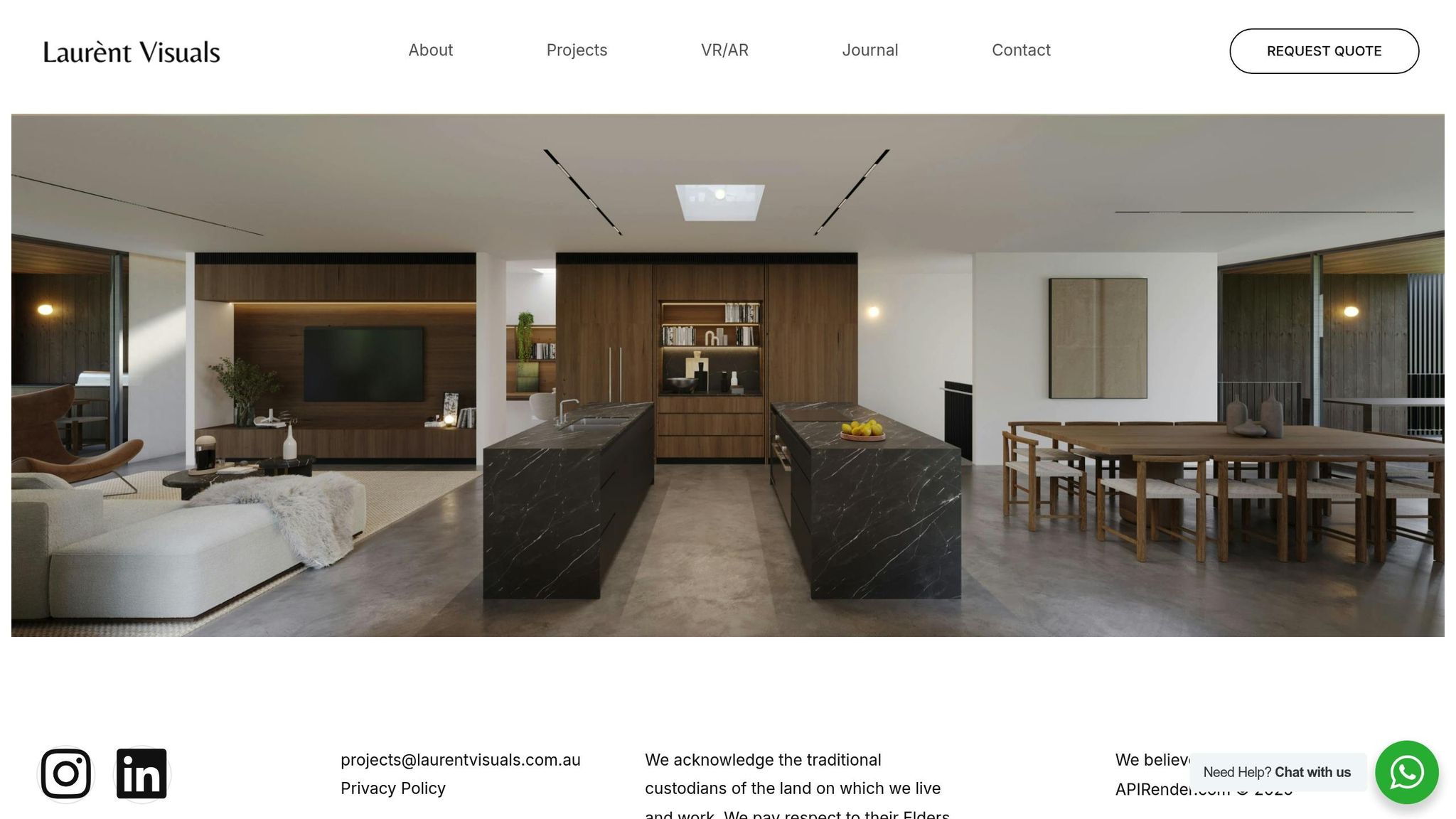
For unique projects that require something extra, Laurent Visuals offers tailored service options designed to meet specific needs. These bespoke solutions can include advanced storytelling elements, virtual reality experiences, and interactive walkthroughs to deeply engage buyers. Whether it’s aerial views, detailed interior staging, or immersive VR presentations, pricing and timelines are customised to align with your project’s scope and goals.
How to Budget for 3D Rendering with Laurent Visuals
Stretch your 3D rendering budget further by selecting the right service level, finalising your project details, and keeping communication clear and efficient.
Building on the pricing structures discussed earlier, here’s how you can make the most of your budget when working with Laurent Visuals.
Choosing the Right Service Level
Laurent Visuals offers two main options: conceptual renders for early-stage approvals and photorealistic visuals for marketing or investor presentations.
To get the best value, match the service level to your project's needs. For example, standard residential renders typically cost between $500 and $1,000 per image. If you're after high-end photorealistic visuals, expect to pay between $2,000 and $5,000 per image. Commercial projects start at $1,000 and increase based on complexity. If your goal is council approval, basic renders will suffice. Save the premium photorealistic images for when you're pitching to investors or launching marketing campaigns.
Reducing Costs with Clear Project Briefs
The more organised and finalised your project details are, the less you'll spend on revisions. Wait until your architectural design is fully finalised before engaging a rendering studio. Why? Mid-project design changes mean extra work - and extra fees. For example, creating a standard 3D render of a modern apartment building typically takes 15 to 24 hours of labour. Any design changes during this process could mean redoing portions of that work.
"Well organised, complete and high quality supporting documentation will make life easier and more efficient. This saves time. And we all know, time is money." – Nick Martin, Founder, Harp Collective
…continued on the original article.