

When it comes to 3D rendering, the cost can range widely - from A$300 to A$6,000 per image. But what do you actually get for the price? Here's the short answer:
- Cheap rendering (A$300–A$850): Quick and basic visuals, suitable for internal use or early-stage approvals. Limited detail, generic textures, and fewer revisions.
- Premium rendering (A$2,500–A$6,000): High-quality, photorealistic images designed for marketing, investor presentations, and pre-sales. Includes custom models, advanced lighting, and expert oversight.
The choice depends on your project's goals. Budget renders work for simple internal needs, while premium renders are essential for high-stakes marketing or sales campaigns. Cheap options save money upfront but may require extra fixes. Premium services cost more but deliver polished results that can boost sales and project success.
The Ultimate Render Engine Comparison for Architects
sbb-itb-1b6d2bc
Quick Comparison
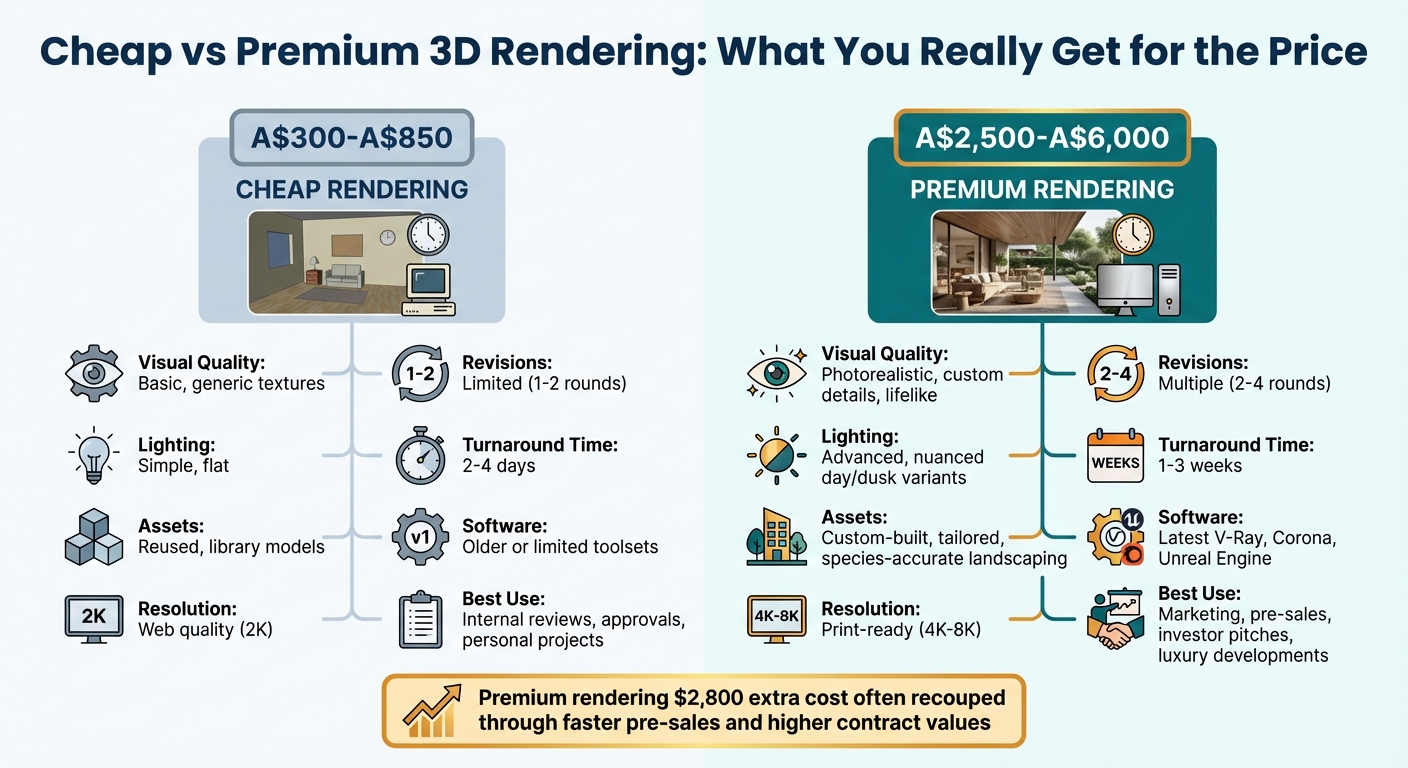
Feature Cheap Rendering (A$300–A$850) Premium Rendering (A$2,500–A$6,000)
Visual Quality Basic, generic textures Photorealistic, custom details
Lighting Simple, flat Advanced, nuanced
Assets Reused, library models Custom-built, tailored
Resolution Web quality (2K) Print-ready (4K–8K)
Revisions Limited (1–2 rounds) Multiple (2–4 rounds)
Turnaround Time 2–4 days 1–3 weeks
Best Use Internal reviews, approvals Marketing, pre-sales, investor pitches
If visuals are key to selling or presenting your project, premium rendering is worth the investment.
What You Get with Cheap 3D Rendering
Budget rendering services, generally costing between A$300 and A$850 per image, are designed to produce straightforward visualisations that communicate spatial intent. While these images serve their purpose, they lack the polish and detail of higher-end renders. Cost savings often come from reusing textures and focusing on speed rather than refinement, resulting in practical but less flexible imagery.
Technical Constraints of Budget Rendering
The limitations of budget-friendly rendering go beyond cost-cutting strategies and extend into technical aspects. Many providers rely on outdated or free software that restricts their ability to create detailed and realistic visuals. Additionally, they often reuse 3D models and textures, leading to a cookie-cutter look. Specific architectural elements like soffits, trims, and detailed landscaping are frequently left out.
This approach impacts the overall quality of the render. Common issues include flat or unrealistic textures, generic shadows, inaccurate finishes, and lighting that feels unnatural. Technical errors, such as improperly scaled elements (e.g., doors that appear too wide or ceilings that seem too low) or mismatched perspectives, can subtly undermine the viewer's confidence in the design.
"Low quality does not have to be ugly… What lower quality often misses is detail and material accuracy." - Abdullah Al Baki, 7cgi
Another issue is hidden costs. Initial quotes might only cover basic work, with extra charges added for high-resolution outputs or even for simply delivering the final images. Many budget services cap image resolutions at web quality and charge extra for print-ready files. These limitations can result in additional expenses to achieve usable results.
Quick Delivery with Limited Refinement
Budget rendering services often prioritise speed, which can be both a benefit and a drawback. While quick turnarounds are appealing, they usually come at the expense of refinement.
"Quantity-focused firms may overpromise, miss deadlines, and charge extra to meet tight timeframes." - Annie Pierson, Designblendz
To save time, these services tend to skip more labour-intensive tasks like custom modelling, fine-tuning lighting, and thorough quality checks. Revision rounds are typically limited to one or two. Communication can also be a challenge, especially with overseas providers where time zone differences and language barriers slow down feedback loops. This rushed process can lead to misinterpretations of design intent, often requiring additional renderings and doubling costs.
When Budget Rendering Makes Sense
There are specific scenarios where budget rendering is a practical choice. For example, it works well for internal design testing during early concept stages, massing studies, or discussions about spatial relationships before finalising a design. It can also be suitable for securing initial approvals, such as Development Applications (DA) or Complying Development Certificate (CDC) submissions, where the focus is on neighbourhood fit and material massing rather than photorealism.
For DIY projects or conceptual designs, these renders can effectively illustrate basic spatial layouts and style options.
However, budget renders are not ideal for high-stakes situations like marketing luxury developments, investor presentations, or pre-sales campaigns. In these cases, subpar visuals can hurt brand perception, slow down sales, and lead to missed opportunities - costing far more than the initial savings. To get the most out of budget services, it's essential to provide clean Revit or CAD models to minimise manual modelling time and consolidate all feedback into a single, clear set of instructions. These factors underscore why budget rendering is only suitable for specific needs, especially when compared to premium options.
What Premium 3D Rendering Delivers
Premium 3D rendering services, priced between A$2,500 and A$6,000 per image, provide a top-service levels solution for architectural visualisation. These services combine advanced software like V-Ray (around A$810.91 annually) and Autodesk 3ds Max (about A$3,065 per year) with high-performance hardware and expert knowledge. The result? Images so detailed and precise that they often rival professional photography, thanks to their accurate lighting, realistic textures, and intricate details.
Professional Software and Advanced Techniques
High-end rendering studios use offline rendering engines that rely on CPU-based path tracing to simulate light behaviour. This includes lifelike reflections, refractions, and shadows, creating images that feel real. Tools like Corona Renderer's Interactive LightMix allow post-render adjustments to lighting, giving artists flexibility. For projects that require interactivity, studios often use Unreal Engine, enabling immersive VR walkthroughs while maintaining high visual quality.
"A good render is not made with the most expensive program. A good render is one that has a careful use of composition, light, and storytelling." - M&Y Models
Post-production is another area where premium services shine. Artists use software like Adobe Photoshop to fine-tune colours, enhance the atmosphere, and add realistic elements like people, vehicles, and landscaping. Cutting-edge tools, including AI denoising, help reduce rendering times, while AI upscaling boosts resolution without losing detail. Additionally, cloud rendering platforms such as Chaos Cloud speed up animation production by utilising powerful server resources, allowing complex projects to be completed in days instead of weeks.
Tailored Visuals and Skilled Artists
While advanced tools are essential, the artistry behind premium renders sets them apart. These studios employ Art Directors to ensure every image not only meets technical standards but also tells a compelling visual story. Many of these artists have backgrounds in architecture or design, giving them an understanding of building codes, construction techniques, and material properties. Unlike budget services that reuse generic assets, premium studios create custom 3D models for furniture, fixtures, and even landscaping tailored to the project.
Attention to local context is another hallmark of premium renders. Artists consider environmental factors like Queensland's intense sunlight or Tasmania's softer lighting, ensuring the visuals feel authentic. They even use species-accurate planting to reflect the project's location. Beyond technical precision, these visuals are designed with marketing psychology in mind - composition, seasonal elements, and lifestyle details are carefully chosen to evoke an emotional connection.
"The best architectural visualisations aren't technical exercises - they're emotional narratives." - Ravelin3D
Multiple Revisions and Quality Control
Premium services also stand out for their commitment to quality and precision. They typically include two to four revision rounds as part of the process, ensuring the final product meets expectations. Projects begin with a thorough review of architectural data, such as CAD or BIM files, to identify and resolve potential issues early on. This proactive approach helps avoid costly mistakes later.
The workflow is methodical, with clear milestones: an initial briefing, a clay model stage for geometry and camera angle approval, a draft render for reviewing materials and lighting, followed by revision rounds, and finally, the high-resolution output.
"Premium studios are known for their unmatched ability to create realistic, captivating renders… they employ dedicated Art Directors." - Michael Falk, Render Vision
Changes are categorised to maintain efficiency - minor tweaks like adjusting colours or angles are included, while significant design changes, such as altering facades or relocating windows, are treated as new work. Dedicated Project Managers act as a single point of contact, ensuring smooth communication and timely delivery. Many studios also provide a warranty period of 30 to 90 days, addressing any issues that may arise after delivery.
Cheap vs Premium 3D Rendering: Direct Comparison
Comparison Across Key Metrics
When it comes to 3D rendering, the price tag often reflects the quality and attention to detail you can expect. The difference between budget and premium rendering services is stark, especially in terms of visual quality and customisation.
Let’s start with visual quality - this is where the gap is most noticeable. Budget renders, which typically cost between A$300 and A$850, often look artificial. They rely on flat textures and frequently reused assets, giving them a generic "CGI feel." On the other hand, premium renders, priced at A$2,500 to A$6,000, deliver photorealistic results. These include lifelike textures, bespoke details, and a level of realism that feels almost tangible. Interestingly, over 80% of 3D visualisation studios in Australia operate in the A$500 to A$1,500 range, highlighting the divide between average and premium standards.
"Choosing a $3,500 hero over a $700 basic render is a $2,800 difference - often recouped if you bring pre-sales forward or nudge contract values even slightly." – Duplex Building Design
Turnaround times also set these services apart. Budget providers promise quick delivery - usually within 2 to 4 days - but their high-volume, assembly-line approach often leads to missed deadlines. Premium studios, however, allocate 1 to 3 weeks for delivery. This extended timeline allows for dedicated project management and ensures reliable, high-quality results. A single high-quality exterior render requires between 15 and 24 man-hours, and rushing this process can inflate costs substantially to 50%. These timeframes can significantly impact project outcomes, whether it’s for internal reviews or critical marketing campaigns.
Here’s a breakdown of how budget and premium rendering compare across key metrics:
Metric Budget Rendering (A$300–A$850) Premium Rendering (A$2,500–A$6,000)
Visual Quality Flat textures; "CGI feel" Photorealistic; custom details; lifelike
Lighting Simple daylight; flat shadows Nuanced day/dusk variants; balanced natural & artificial
Assets Library objects; recycled Bespoke 3D models; species-accurate landscaping
Resolution Web-resolution (2K); extra charges for higher output Print-ready (4K–8K) included
Revisions Limited revisions; extra charges for changes 2–3 rounds included in base price
Turnaround 2–4 days (with potential delays) 1–3 weeks (dedicated project management)
Software Older or limited toolsets Latest V-Ray, Corona, Unreal Engine
Best Application Internal design checks; HOA approvals; personal projects Luxury marketing; investor presentations; pre-sales campaigns
Premium rendering services are indispensable when visuals play a critical role in driving pre-sales, securing investor interest, or marketing luxury developments. These high-quality renders don't just showcase a project - they create an emotional connection that can directly influence sales.
How to Choose the Right Rendering Service
What to Consider Before Deciding
…continued on the original article.