

Architectural renders are highly detailed 3D visuals created from plans, offering a clear preview of a property before construction begins. In Australia’s real estate market, these renders are essential for off-the-plan sales, helping buyers visualise unbuilt homes and boosting confidence in their investment. They’re widely used across websites, brochures, and social media, delivering immersive visuals that highlight design, finishes, and lifestyle features.
Key points:
- Boosts off-the-plan sales: Helps developers secure pre-sales by showcasing clear, realistic property visuals.
- Photorealistic details: Depicts materials, lighting, and layouts to build trust and reduce hesitation.
- Emotional connection: Engages buyers by helping them imagine living in the space.
- Multiple uses: Effective for brochures, websites, and virtual walkthroughs.
- Localisation matters: Tailoring renders to Australian standards (e.g., metric measurements, local landmarks) enhances buyer trust.
Choosing the right tools is crucial. Lumion offers fast, real-time rendering for quick updates, while V-Ray excels in creating lifelike, high-quality visuals for premium marketing. Combining these tools ensures both efficiency and exceptional output. Whether for small projects or large campaigns, architectural renders are a cornerstone of property marketing in Australia.
Benefits of 3D Renders for Marketing Brochures and Websites
Improved Off-the-Plan Sales
Off-the-plan sales play a critical role in Australian property development, providing developers with the early cash flow needed to kickstart construction. But convincing buyers to commit to a property that doesn’t yet exist? That’s a big challenge. This is where 3D renders step in and change the game.
"Selling off the plan is extremely vital for cash flow in these big residential developments. Being able to showcase 3d renders that are photorealistic and show the plans looking the best can be the difference between selling at a high price vs a low price." – The 3D Architect
By transforming blueprints into clear, visually appealing images, 3D renders remove the guesswork for potential buyers. They highlight design details, finishes, and layouts in a way that’s easy to understand, speeding up decisions and securing pre-sales months - or even years - before construction begins. This visual clarity builds confidence, giving buyers a tangible sense of what they’re investing in.
Photorealistic Property Visualisation
The benefits of 3D renders go beyond just speeding up sales - they also provide a level of realism that instils trust in buyers. When renders accurately depict materials, lighting, and proportions, they create a sense of reliability and reduce hesitation. Conversely, low-quality visuals can have the opposite effect, driving potential buyers away.
Imagine seeing how sunlight streams into a living room or how sleek stone cladding pairs with warm timber accents on a townhouse. These details bring a property to life, offering buyers a glimpse of not just what the space will look like, but how it will feel to live there. Traditional 2D drawings or even physical scale models simply can’t compete with this level of immersion.
Better Buyer Engagement
When you combine clarity with realism, you get something powerful: emotional engagement. Marketing materials aren’t just about presenting facts - they’re about creating a connection. High-quality 3D renders allow buyers to visualise themselves in a space, experiencing the lifestyle it offers before it’s even built.
"3D renders for project marketing are crucial in creating compelling visual content that captures attention and drives engagement." – Laurent Visuals
Incorporating features like local landscaping, nearby buildings, and lifestyle elements helps establish a sense of place. This emotional resonance can turn a casual browser into a committed buyer, especially for those who can’t visit the site in person. By presenting not just a property but an entire living experience, 3D renders elevate marketing efforts to a whole new level.
Real Estate Renderings
Key 3D Rendering Techniques for Marketing Materials
The choice of rendering technique depends on the story you want to tell and the platform you're using. Whether it's a wide-angle hero shot or an immersive virtual tour, each method brings something distinct to your marketing arsenal. These approaches build on earlier benefits by tailoring visuals to specific marketing goals.
Photomontages and Streetscapes
Photomontages combine 3D models with real-world photography to show how a new development fits into its surroundings. This is especially useful in Australia, where local councils often require visual demonstrations to ensure new projects complement the existing urban environment. By including neighbouring buildings, streetscapes, and local features, photomontages offer a level of context that standalone renders simply can't match.
For these images to feel seamless, matching the lighting conditions is essential. Sun study effects can replicate the exact time of day and weather patterns of the actual location, making the integration appear more natural. A focal length range of 24–35mm is ideal for capturing architectural designs within their real-world context, striking the right balance between perspective and detail.
Interior and Exterior Renders
Exterior renders generally fall into two categories: hero shots and vignettes. Hero shots use wide-angle lenses (16–35mm) to capture a building's most striking angles, making them perfect for brochures and billboards. Vignettes, by contrast, zoom in on specific architectural details - like the texture of stone cladding or the interplay of timber and glass - highlighting craftsmanship that might otherwise go unnoticed.
Interior renders follow a similar approach. Wide-angle shots are great for showcasing the layout, scale, and flow of a space, making them ideal for website galleries where a comprehensive view is critical. On the other hand, interior vignettes (35–150mm) focus on luxury details like designer fixtures, stone benchtops, or freestanding baths. These close-ups evoke a sense of aspiration and often perform exceptionally well on platforms like Instagram. To maintain a perspective that feels natural, set the camera height between 1.5–1.8m, which aligns with the human eye.
Virtual Walkthroughs and Animations
Virtual walkthroughs have become indispensable for buyers who can't visit a site in person.
"Virtual house walkthroughs are a game-changer in property sales, especially for buyers who may be located in different regions or countries." – Laurent Visuals
To optimise these walkthroughs, use Level of Detail (LOD) techniques. This ensures high detail where the camera focuses while keeping render times manageable. Short, eye-catching animation clips work incredibly well on social media platforms like Instagram and Facebook, where visual content generates 2.3 times more engagement than text-only posts. Full-length walkthroughs, however, are better suited for project websites, allowing potential buyers to explore at their own pace.
Real-time ray tracing is another valuable tool, as it instantly validates lighting and design choices. This reduces the need for revisions and speeds up project timelines - critical when working under tight marketing deadlines.
Photorealistic Renders vs Conceptual Renders for Marketing
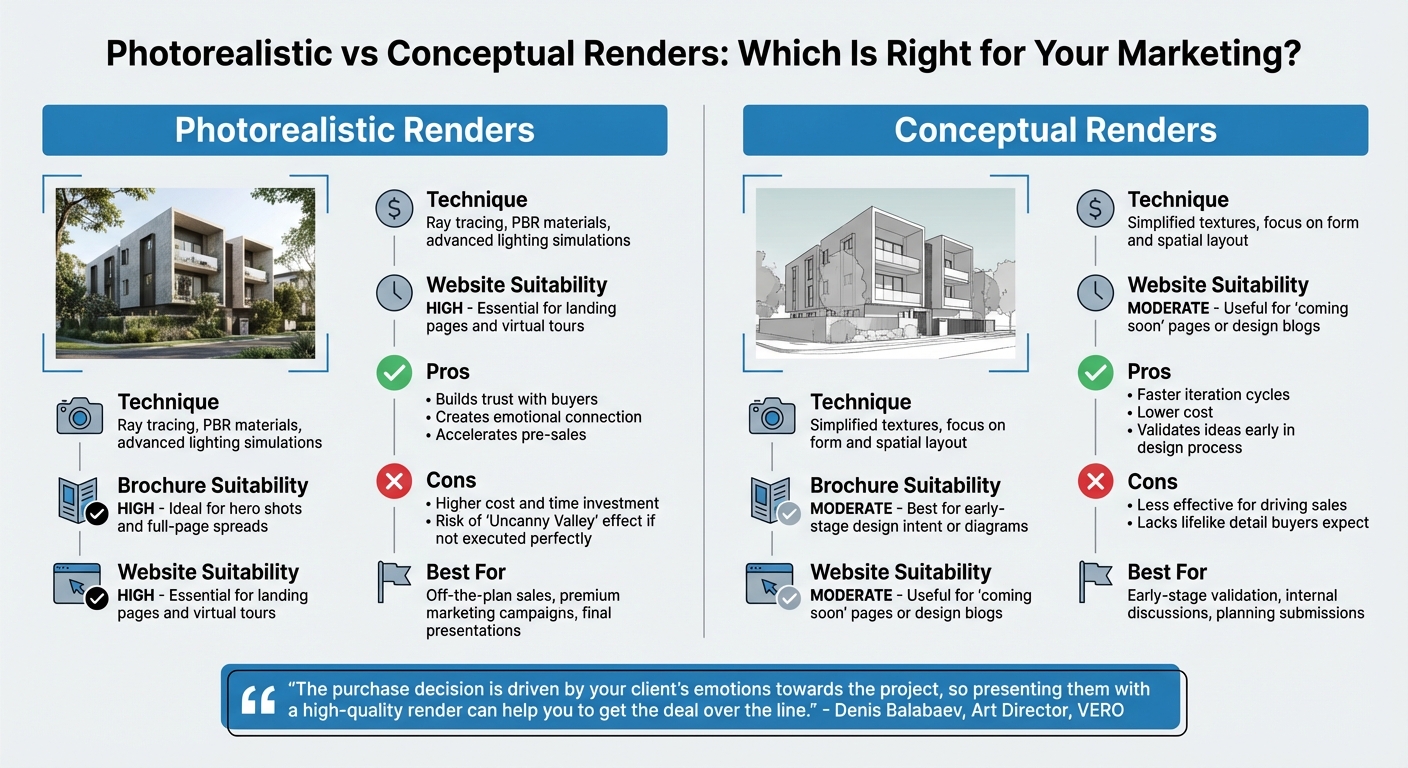
Choosing the right type of render depends on your marketing goals. Photorealistic renders excel in showcasing lifelike details, using techniques like ray tracing and PBR (Physically Based Rendering) materials to mimic reality with precision. These renders are perfect for building buyer trust by vividly illustrating completed features - whether it's the grain of timber cladding or the way sunlight streams into a kitchen. This level of realism is especially valuable for off-the-plan sales, helping potential buyers imagine their future space.
On the other hand, conceptual renders prioritise the design's form, volume, and intent over hyper-realistic details. They are quicker and more cost-effective, making them suitable for early-stage design validation when material decisions are still in flux. These renders often use simplified textures or artistic effects, like watercolours, to convey the overall feel of a project. While useful for internal discussions or planning submissions, they may lack the polished look needed to inspire buyer confidence.
"The purchase decision is driven by your client's emotions towards the project, so presenting them with a high-quality render can help you to get the deal over the line." – Denis Balabaev, Art Director, VERO
However, achieving photorealism comes with its challenges. One notable risk is the "Uncanny Valley" effect, where almost-perfect visuals can feel unsettling if lighting or materials seem slightly off. Avoiding this requires meticulous attention to detail to ensure renders feel natural and convincing.
Below is a comparison of the features and marketing suitability of photorealistic and conceptual renders.
Comparison Table
Feature Photorealistic Renders Conceptual Renders
Technique Ray tracing, PBR materials, advanced lighting simulations Simplified textures, focus on form and spatial layout
Brochure Suitability High; ideal for hero shots and full-page spreads Moderate; best for early-stage design intent or diagrams
Website Suitability High; essential for landing pages and virtual tours Moderate; useful for "coming soon" pages or design blogs
Pros Builds trust, creates emotional connection, accelerates pre-sales Faster iteration, lower cost, validates ideas early
Cons Higher cost and time; risk of "Uncanny Valley" discomfort Less effective for sales; lacks lifelike detail for buyers
Software Tools for Architectural Rendering
When it comes to crafting marketing visuals that leave an impression, the right software can make all the difference. Among the many rendering tools available, Lumion and V-Ray stand out, each excelling in different areas: Lumion shines with its speed and real-time capabilities, while V-Ray is unmatched in delivering photorealistic detail. Choosing the right tool depends on the balance you need between quick turnarounds and the visual quality that can turn prospects into buyers. Let’s take a closer look at how these tools deliver on their strengths.
Lumion for Real-Time Rendering
Lumion’s standout feature is its real-time rendering engine, which allows you to see changes as you make them - no waiting around for lengthy render times. Its LiveSync feature integrates seamlessly with CAD programs like SketchUp and Revit, instantly reflecting adjustments.
"Lumion ensures rapid modifications and high-quality renders under tight deadlines." ― Lorenzo Langella, Associate Architect, Studio Transit
The 2025 version of Lumion Pro takes things further with an AI image upscaler capable of producing up to 8K outputs, speeding up rendering by up to five times compared to traditional methods. This makes it ideal for generating large-format images, like those used in print brochures, in record time. Plus, with a library of over 6,200 pre-built models, including 2,300+ nature elements and 900+ characters, you can quickly add context and life to your designs.
But Lumion isn’t just about static images. It also excels in creating cinematic walkthroughs and 360° panoramas - perfect for immersive website experiences. Features like HDRI skies, weather effects, and custom colour correction let you set the perfect mood. Tools such as the 2-point perspective effect ensure vertical lines stay straight, while sun studies simulate natural lighting conditions, giving your visuals a realistic edge.
V-Ray for Photorealistic Outputs
While speed is critical for some projects, others demand an unparalleled level of realism. That’s where V-Ray steps in. Known for its ability to produce visuals so lifelike they make viewers look twice, V-Ray is the go-to for photorealistic rendering. It integrates with popular software like 3ds Max, SketchUp, and Rhino, offering precise control over lighting and material behaviour to achieve stunningly realistic results.
"V-Ray ensures every detail is communicated clearly." ― Chaos
V-Ray’s advanced global illumination and fine-tuned material settings create lifelike reflections, shadows, and textures that can enhance buyer confidence. This attention to detail becomes invaluable for hero shots - those key images used in brochures or website landing pages. Whether it’s the grain in timber flooring, the way sunlight filters through sheer curtains, or the subtle weathering on exterior materials, these details help potential buyers emotionally connect with a property they haven’t yet visited.
…continued on the original article.