

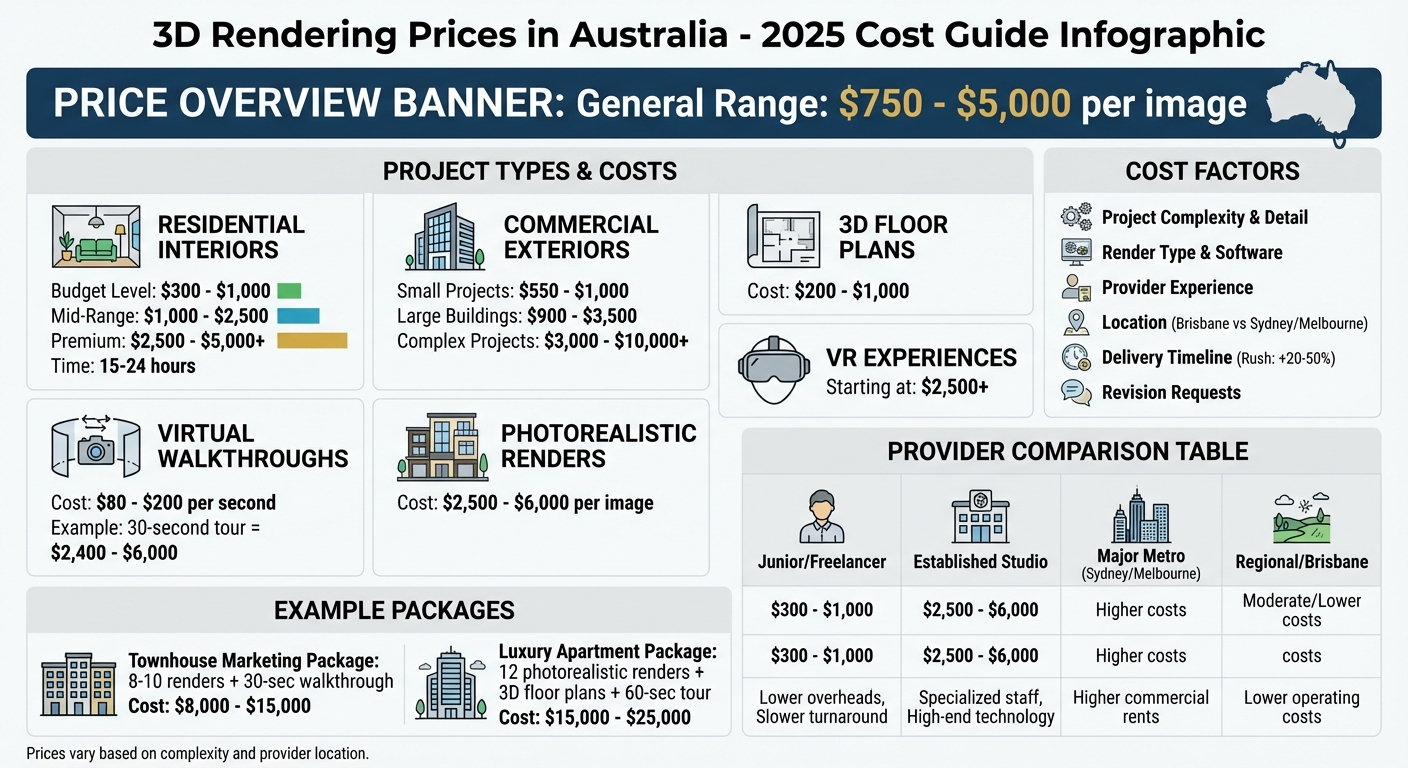
If you're planning a property or architectural project in Australia, 3D rendering costs in 2025 range from $750 to $5,000 per image, depending on complexity and detail. Here's a quick breakdown:
- Residential interiors: $300–$5,000+ per image.
- Commercial exteriors: $550–$10,000+ per image.
- 3D floor plans: $200–$1,000.
- Virtual walkthroughs: $80–$200 per second.
- Photorealistic renders: $2,500–$6,000 per image.
Costs are influenced by project complexity, software used, provider experience, location, and delivery timelines. Brisbane studios tend to charge less than Sydney or Melbourne due to lower costs. Finalising designs and providing clear briefs can help manage costs.
High-quality renders are an investment that can accelerate pre-sales, improve client understanding, and support marketing efforts.
House Animation 4D Building Cost Estimation based in Queensland Australia
What Affects 3D Rendering Costs in Australia
The cost of 3D rendering services in Australia depends on several interconnected factors, including labour, processing time, and the artistic expertise required. By understanding these aspects, you can better evaluate quotes and select the right service for your needs.
Project Complexity and Detail Requirements
The complexity of your project plays a big role in determining costs. A simple, single-storey modern home with clean lines is less expensive to render than a multi-storey Victorian-style property with intricate details like turrets, ornate facades, and decorative features. Exterior renderings tend to be more expensive than interior ones because they involve additional elements like landscaping, pools, fences, driveways, and even nearby structures.
For interiors, the size and scope matter. For instance, rendering a small bedroom is far less costly than a large open-plan living area with features like butler's kitchens, fireplaces, or double-height ceilings. Custom assets can also raise costs - if your project includes unique furniture, specific plants, or other one-of-a-kind props, these will need to be modelled from scratch. This can add anywhere from $25 to $150 per item. Providing clear and detailed documentation can help reduce model cleanup time, which in turn lowers costs. Finalising your architectural design before engaging a studio is another way to avoid costly revisions caused by design changes.
Render Type and Software Used
The type of rendering and software chosen can significantly influence pricing. For example, real-time rendering is generally less expensive than ray tracing, which demands more processing power and time. High-quality, photorealistic renders require advanced hardware and, in some cases, external "render farm" services - especially for projects with tight deadlines.
"The amount of time that it takes to render images is directly proportional to their size and how realistic they are. Higher quality images naturally take longer and use more powerful computers." - Render Vision
Using existing design assets, such as CAD or BIM (Building Information Modelling) files, can streamline the modelling phase and reduce costs. On the other hand, if a studio has to create models from scratch due to incompatible files, prices will increase. Basic renders created using standard BIM/CAD software are generally the most affordable, costing between $100 and $250, while professional-grade tools like 3ds Max or Revit used by specialists command higher rates.
Provider Experience and Location
Experience matters when it comes to 3D rendering. Skilled professionals typically charge more, but they also work more efficiently, make better creative decisions, and produce higher-quality results. A standard 3D render of a modern apartment building, for example, might require 15 to 24 man-hours to complete.
"Experience matters - skilled artists work faster and produce fewer errors, which saves you money." - Alex Smith, Manager & Co-Owner, Render 3D Quick
Location also plays a role in pricing. Studios in Brisbane often charge less than those in Sydney or Melbourne due to lower operating costs. Australian-based studios also have an edge in understanding local architecture, native vegetation, and buyer preferences, which ensures renders are tailored to the domestic market.
Provider Type Price Range (AUD) Key Characteristics
Junior/Freelancer $300–$1,000 Lower overheads; may have slower turnaround or less consistent quality
Established Studio $2,500–$6,000 Access to specialised staff and high-end technology; proven reliability
Major Metro (Sydney/Melbourne) Higher Higher commercial rents and living costs reflected in prices
Regional/Brisbane Moderate/Lower Lower operating costs make services more affordable
Delivery Time and Revision Requests
Tight deadlines can drive up costs as studios may need to allocate extra resources or charge premium fees. Most studios include one or two minor revision rounds in their pricing. However, major structural changes after the initial model is built often come with additional hourly fees. Repeated revisions, especially those involving design changes rather than minor tweaks, can quickly inflate your budget.
To keep revision costs under control, provide detailed plans, material references, and mood boards from the start to minimise research time. If you need multiple views of the same project, request them all at once; since the 3D model is built only once, the cost per additional angle is usually lower. By considering these factors, you can create a clear roadmap for budgeting your 3D rendering project in Australia.
2025 Price Ranges for Common Projects
Understanding the costs of 3D rendering projects can help you plan your budget effectively. Prices vary depending on the project's scope, level of detail, and the intended use of the final images.
Residential Interior Renders
Here’s what you can expect to pay for residential interior renders, which are typically priced per image. Costs range from $300 to $5,000+, depending on the complexity and quality required.
- Budget-level renders: For simpler spaces with basic lighting and minimal custom furniture, prices fall between $300 and $1,000.
- Mid-range renders: These are the go-to choice for real estate marketing and typically cost $1,000 to $2,500.
- Premium renders: High-end designs featuring intricate details, custom furniture, and advanced textures can cost anywhere from $2,500 to $5,000 or more.
Creating a high-quality render of a standard apartment interior usually takes 15 to 24 hours of work.
"One of the main goals for architectural renderings is to achieve photorealism. We want people to believe this is a photo of a real building." – Nick Martin, Author, Harp Collective
Most studios include one to two rounds of revisions in their base pricing, with extra changes billed separately. If you need multiple angles of the same room, the cost per image often drops since the 3D model only needs to be created once.
Commercial Exterior Renders
Rendering commercial exteriors tends to cost more than residential interiors because of the larger scale and added complexity. Here’s a breakdown:
- Small commercial exteriors: Projects like retail units or single-storey offices range from $550 to $1,000.
- Large commercial buildings: Multi-storey offices or mixed-use developments typically cost $900 to $3,500.
- Complex projects: Skyscrapers, shopping centres, or landmark developments can cost $3,000 to $10,000 or more.
3D Floor Plans and Virtual Walkthroughs
Interactive visualisations like 3D floor plans and virtual walkthroughs provide an immersive way to explore spaces. Here’s what these services usually cost:
- 3D floor plans: For commercial projects, prices range from $200 to $1,000, with residential plans generally at the lower end.
- Virtual walkthrough animations: These are priced at $80 to $200 per second of completed footage. For example, a 30-second walkthrough would cost between $2,400 and $6,000.
- Interactive virtual tours: Basic tours start at around $350.
Photorealistic Renders and VR Experiences
For projects requiring top-service levels quality, photorealistic renders and virtual reality (VR) experiences are the premium options:
- Photorealistic renders: These high-end images, ideal for luxury property marketing or investor presentations, cost between $2,500 and $6,000 per image.
- VR experiences: Fully immersive walkthroughs begin at $2,500, with costs rising based on the number of spaces and the level of interactivity.
High-resolution renders in 4K or 6K formats demand more processing power and time, which increases costs. Additionally, rush deadlines for these premium services can add 20% to 50% to the total price.
sbb-itb-1b6d2bc
Example Project Costs in Australia
Here’s a look at some pricing examples for various project types in Australia, giving you a sense of what to expect based on your needs.
Single-Room Interior Renders
For residential interior renders, prices generally range between $450 and $850, fitting into what’s often called the "Standard" service levels. These are perfect for council approvals or smaller residential projects, with a typical turnaround of 2 to 4 days.
If you’re aiming for a more polished result - often referred to as the "Gold Standard" - costs increase to $650 to $3,000. This level is ideal for real estate marketing and includes features like enhanced lighting, higher-quality textures, and 2 to 3 rounds of revisions. Delivery times for this service levels usually fall between 3 and 7 days.
Providing detailed plans and material references can help streamline the process and reduce clarification time. Additionally, ordering multiple angles may lower the cost per image. Now, let’s see how prices scale when dealing with larger, more complex exterior projects.
Multi-Storey Exterior Projects
Rendering a four-storey apartment building in Melbourne or Sydney typically costs between $900 and $3,000 per image. Pricing depends on factors like facade details, landscaping, and whether aerial or drone-style perspectives are required, which can push costs to the higher end.
For six-storey, mixed-use developments, the cost increases to $2,000 to $5,000 per render. These projects often require 1 to 2 weeks to complete, though timelines for larger developments may stretch to 5 weeks. Most quotes include 2 to 3 rounds of revisions, but if you’re on a tight deadline, expect to pay an additional 20% to 50% premium for rush jobs due to overtime and external rendering resources.
"This service levels of 3D rendering [$3,000+] is for companies and corporations with large-scale projects and looking for rendering service options with an abundance of revisions." – Render Vision
Interestingly, Brisbane-based studios tend to charge less than their Melbourne or Sydney counterparts, thanks to lower operating costs. For projects that blend interior and exterior elements, bundled marketing service options can offer better value.
Real Estate Marketing service options
For townhouses, marketing service options that include 8 to 10 renders and a 30-second walkthrough typically cost between $8,000 and $15,000. Bundling services often reduces per-image costs substantially to 25%.
Luxury apartment projects require a more premium touch. service options featuring 12 photorealistic renders, 3D floor plans, and a 60-second virtual tour are priced between $15,000 and $25,000. These are particularly useful for off-the-plan sales and investor presentations, where high-quality visuals can help developers achieve pre-sale targets faster.
"Investing in high-quality 3D renders can yield significant returns in terms of project success, client satisfaction, and market impact." – Laurent Visuals
service options generally take 1 to 3 weeks to complete. To keep costs under control, it’s best to finalise your architectural design before commissioning a full service options and provide consolidated feedback during the included revision rounds.
2025 Pricing Trends in Australia
When budgeting for 3D rendering projects, it's essential to keep an eye on trends shaping the Australian market. The landscape is shifting rapidly, driven by new technologies and changing client demands, which are influencing how studios price their services and deliver results.
AI and GPU Rendering Technology
Advancements in AI and GPU hardware are making professional-quality renders more accessible than ever. AI-powered tools now enable studios to provide quick, transparent estimates and streamline their workflows, cutting down on the time spent on repetitive tasks. This allows skilled professionals to focus on the creative aspects of a project, enhancing efficiency and reducing errors. These improvements are also aligning with the rising demand for renders that support sustainable design narratives.
"Innovations in cloud computing, AI, and hardware are likely to continue driving down costs, making high-quality rendering available to a wider audience." – Laurent Visuals
However, it's worth noting that high-end photorealistic renders still require substantial computational power and expert post-processing to meet professional marketing standards. Projects aiming for the finest 4K or 6K outputs may also incur additional render-farm fees.
Growing Demand for Sustainable Design Renders
…continued on the original article.