

When budgeting for 3D rendering in Australia, understanding cost drivers is essential. Prices depend on factors like project complexity, detail, and deadlines. For example:
- Basic renders (e.g., council submissions): ~$300–$850
- Marketing-grade photorealistic renders: ~$1,000–$6,000
- Specialised services (e.g., aerial views, animations): ~$600–$8,000+
Costs are influenced by labour hours, expertise, and resources. Larger, intricate projects or rush jobs tend to cost more. Providing clean CAD/Revit files and finalised designs can reduce expenses by 15–30%. For the best results, choose a provider with a strong portfolio and local knowledge.
How To Price Your Arch Viz Projects | BONUS!! Free Sheet Calculator
What Affects 3D Rendering Prices
The cost of a 3D render isn't random - it’s based on the time, expertise, and resources involved. A simple formula to keep in mind: cost = (labour hours × studio rate) + additional fees like licences, extra assets, or rush charges.
Labour is the biggest factor, with the scope of the project directly influencing the hours required. For example, rendering a single-storey home with a small garden is far less time-intensive than creating a detailed 30-storey apartment complex with commercial spaces. The scale, style, and level of detail all play a role in determining how much work is needed.
Design intricacy is another key factor. Projects with complex facades, Victorian-style architecture, or intricate geometric patterns take significantly more time to model compared to simpler, modern designs. Abdullah Al Baki, Founder and Creative Director at 7cgi, highlights this by saying, "a 5,000 sq ft classic interior can cost up to three times more than a 5,000 sq ft modern interior because classic styles demand richer detailing, ornamentation, and longer look-development". The architectural style you choose has a direct impact on your overall budget.
The context of the site and customisation requirements also add to the workload. Including surrounding elements like roads, buildings, topography, and landscaping increases the complexity of the project. If branded furniture or rare plant species need to be modelled from scratch, this will raise the cost further. On the other hand, providing pre-built 3D models from Revit or BIM can meaningfully reduce sales cycles to 30%.
Let’s break down the main elements - project size, design complexity, context, and technical expertise - that shape rendering costs.
Project Size and Complexity
The scale of a project immediately impacts the resources required. Interior renders are typically priced based on the number of rooms and the amount of "staging" needed, such as furniture, decor, and styling. Exterior renders, on the other hand, are influenced by landscaping, terrain, and the surrounding environment. A single room with minimal furnishings is far less demanding than a multi-storey commercial building with detailed ground-floor retail spaces.
Commercial projects generally cost more than residential ones due to their larger size, complex lighting setups, and the need for multiple revision rounds to accommodate various stakeholders. However, bundling multiple views of the same project often results in a lower per-image rate, as the primary 3D model only needs to be created once.
To manage costs, finalise your design before starting the rendering process. Changes to the geometry after work has begun can be expensive and may require a complete re-render. Providing clean CAD, Revit, or BIM files can also save time that would otherwise be spent on cleanup or remodelling, which helps lower the overall quote.
Detail Level and Image Quality
The difference between a basic concept render and a highly detailed, photorealistic image comes down to the time spent on fine-tuning. High-quality renders require careful attention to textures, lighting, and architectural details to mimic real-world appearances. This level of precision demands additional hours from skilled artists.
Resolution and output requirements also affect pricing. Images intended for large-format prints or premium marketing materials need higher resolutions, which require more rendering power and time. To balance quality and cost, you might opt for lower-detail renders for internal discussions or council approvals, while reserving high-detail outputs for sales and marketing. Providing clear documentation and material schedules to your rendering team can also minimise revisions and reduce costs.
Delivery Timeframes
Tight deadlines come with added costs. Rush projects (typically those needed within 72 hours) often carry a 20–50% surcharge. While most 3D rendering projects take one to three weeks, some studios can deliver in as little as four or five days, depending on the scope.
Fast turnarounds require overtime, additional artists, external high-powered render farms, and expedited revisions - all of which drive up costs. External render farms, which are essentially remote computer clusters, often come with usage fees. Planning ahead can help you avoid these rush charges; scheduling your project even a week earlier can make a noticeable difference. Consolidating feedback into a single round also helps prevent scope creep and additional hourly fees.
Both time constraints and the expertise required to meet them play a major role in determining the final price.
Technical Resources and Skills
The equipment and expertise needed for rendering also impact costs. Studios invest in high-end hardware and software licences to produce high-resolution outputs. These resources demand significant rendering power and processing time. Additionally, the experience of the artists and the studio’s reputation can influence pricing - more skilled talent and established studios charge higher rates for their consistent results.
Beyond the initial render, post-processing work such as adding effects or performing colour corrections in Photoshop can also increase costs. Studios with a proven track record often charge premium rates, but they deliver reliable, high-quality results.
Price Ranges by Project Type
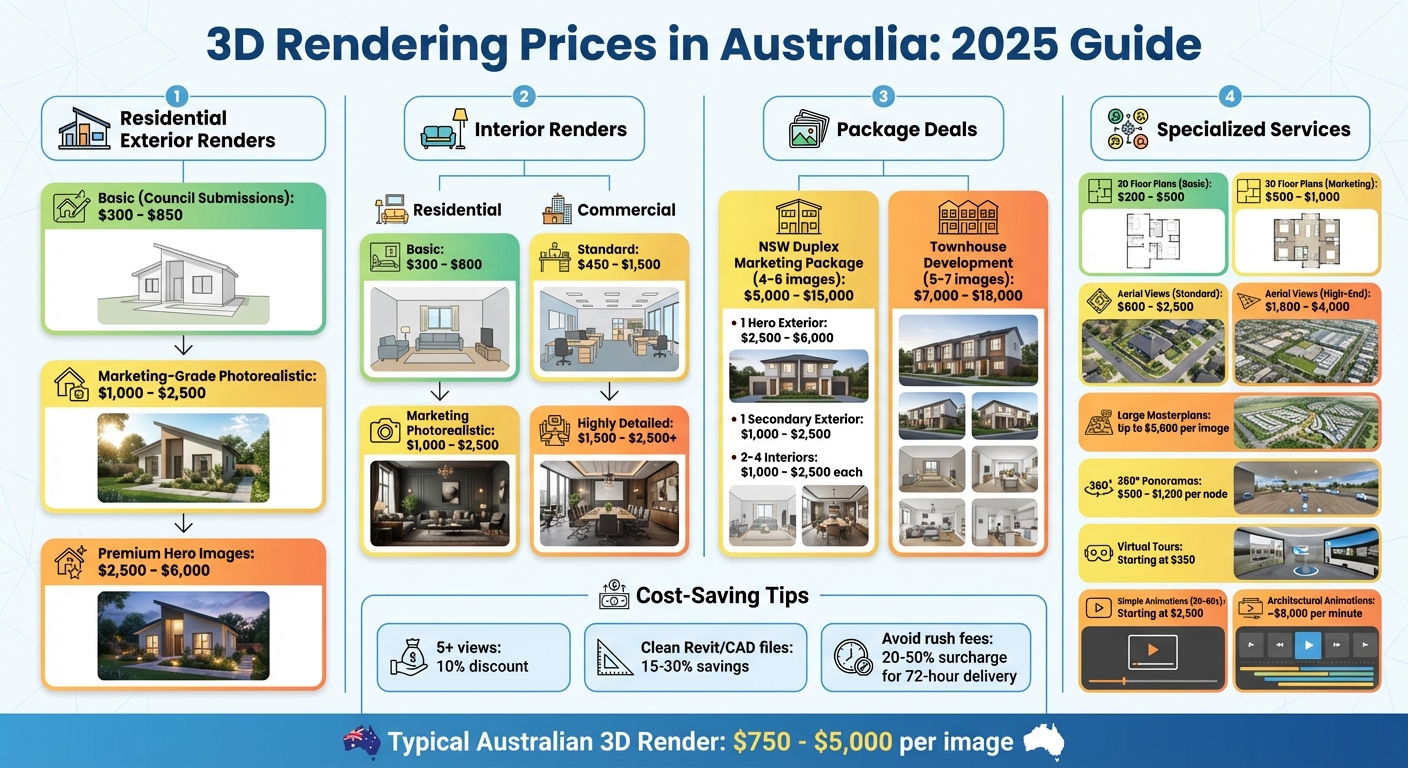
Knowing the typical costs for various render types can help you plan your budget and decide on the right level of detail. In Australia, 3D renders generally cost between A$750 and A$5,000 per image, depending on the complexity and intended use. Studios often charge per image, but for larger projects, bundled pricing can reduce the cost per view. Here’s a breakdown of pricing by render type to give you a clearer picture.
Exterior and Interior Renders
For residential exteriors, basic renders for duplexes designed for council approvals typically cost A$300 to A$850. On the other hand, photorealistic marketing-grade renders range between A$1,000 and A$2,500, while premium "hero" images used in high-end campaigns can cost anywhere from A$2,500 to A$6,000.
Interior renders follow a similar pricing structure. Basic residential interiors start at A$300 to A$800, while photorealistic marketing interiors are priced at A$1,000 to A$2,500. For commercial interiors, prices are higher: A$450 to A$1,500 for standard renders and A$1,500 to A$2,500+ for highly detailed versions.
"Choosing a $3,500 hero over a $700 basic render is a $2,800 difference - often recouped if you bring pre‑sales forward or nudge contract values even slightly." – Nathan Battishall
In October 2025, Duplex Building Design provided a benchmark for a NSW duplex marketing service options (4 to 6 images) at A$5,000 to A$15,000. This typically includes one hero exterior (A$2,500 to A$6,000), one secondary exterior (A$1,000 to A$2,500), and 2 to 4 interiors (A$1,000 to A$2,500 each). For townhouse developments, a standard 5 to 7-image campaign costs A$7,000 to A$18,000, depending on whether aerials or photomontages are included.
Ordering five or more views often qualifies for a 10% discount, and providing clean Revit or CAD files can reduce costs by 15–30%. Most quotes include 1 to 3 revision rounds, but additional changes beyond that usually incur hourly fees.
Aerial Views and Floor Plans
Specialised render types like aerial views come with distinct pricing. These renders are more expensive than standard exteriors because they require modelling a larger site context, including surrounding buildings, streets, and terrain. Prices for standard aerials range from A$600 to A$2,500, while high-end versions featuring custom landscaping, traffic, and people can cost A$1,800 to A$4,000. For large-scale masterplans or multi-tower projects, the cost can reach A$5,000 per image.
3D floor plans are among the most affordable options, starting at A$200 to A$500 for basic layouts and increasing to A$500 to A$1,000 for marketing-grade versions with detailed furnishings. Commercial floor plans are priced higher - usually 50% to substantially more - due to their larger size and complexity. Studios often charge per level or per unit type, with discounts available for multiple layouts.
Other specialised services include 360° panoramas priced at A$500 to A$1,200 per node and virtual tours starting at A$350. Simple fly-through animations (30 to 60 seconds) typically start at A$2,500, while more elaborate architectural animations are priced around A$8,000 per minute.
sbb-itb-1b6d2bc
How Location Affects Pricing in Australia
Where a studio is based plays a big role in determining render prices. Studios in cities like Sydney and Melbourne tend to charge more because of higher operating costs, including steep commercial rents, wages, and living expenses. In comparison, studios in Brisbane or regional areas often have lower rates due to reduced overheads [6,18]. These cost differences are closely tied to local market demands and the expenses of running a business in each area.
"Rates can vary depending on the region in Australia, with major cities like Sydney and Melbourne typically having higher costs." – Sarah Thompson, Coohom
Brisbane-based studios, for example, often provide more competitive pricing while still delivering comparable quality. The lower costs are a result of reduced operating expenses, not a lack of skill or expertise. However, hourly rates will always reflect the studio's location.
Another factor to consider is local expertise. Studios familiar with regional requirements can make the approval process smoother. For instance, Sydney or Newcastle-based studios understand the nuances of NSW council expectations for DA and CDC submissions, helping to avoid delays. Similarly, Brisbane-based designers often have a deeper understanding of Queensland’s architectural styles and buyer preferences, ensuring their renders resonate better with the local market.
That said, thanks to digital workflows, you’re not limited to working with studios in your area. Opting for a studio with strong local knowledge can provide benefits that go beyond just the initial cost [1,9].
How to Choose a 3D Rendering Provider
Evaluating Quality and Experience
Start by reviewing the provider's portfolio. Look for photorealistic renders - images that look so realistic they could be mistaken for actual photographs. The key elements to watch for include natural lighting, realistic shadows, and accurate textures. Consistency across their work is just as important; inconsistent quality might suggest some of their work is outsourced.
Pay attention to the finer details that separate good renders from outstanding ones. For example, landscaping and vegetation should reflect the project's location, such as including Australian-native plants for local developments. Similarly, interior renders should showcase thoughtful styling, with furniture and décor that are both modern and visually appealing. Top-service levels studios often employ professional stylists to achieve this. A trustworthy provider will display a diverse portfolio, covering everything from small residential homes to large-scale commercial projects.
"The quality will remain once the price is forgotten." – Nick Martin, Author, Harp Collective
Take time to verify the team behind the work. Check their website for staff profiles and look up their credentials on LinkedIn. A physical office address listed on their website is another sign of an established and reliable studio. Typically, professional 3D rendering artists have at least 5–10 years of experience, which reflects both their expertise and ability to deliver efficiently.
Getting Quotes and Defining Project Scope
Once you're confident in a provider's quality and experience, it’s time to discuss pricing and project details. Request itemised quotes that outline deliverables, resolution, revision limits, and any extra costs, such as custom assets or expedited timelines. This level of detail ensures you can make an apples-to-apples comparison between providers. Most professional quotes will include one or two rounds of revisions, so confirm the cost of any additional changes before committing.
To avoid surprises later, provide comprehensive documentation upfront. This includes clean Revit or CAD files, finalised material schedules, and a clear shot list. These details help the provider deliver accurate quotes and reduce the risk of expensive revisions later on.
…continued on the original article.