
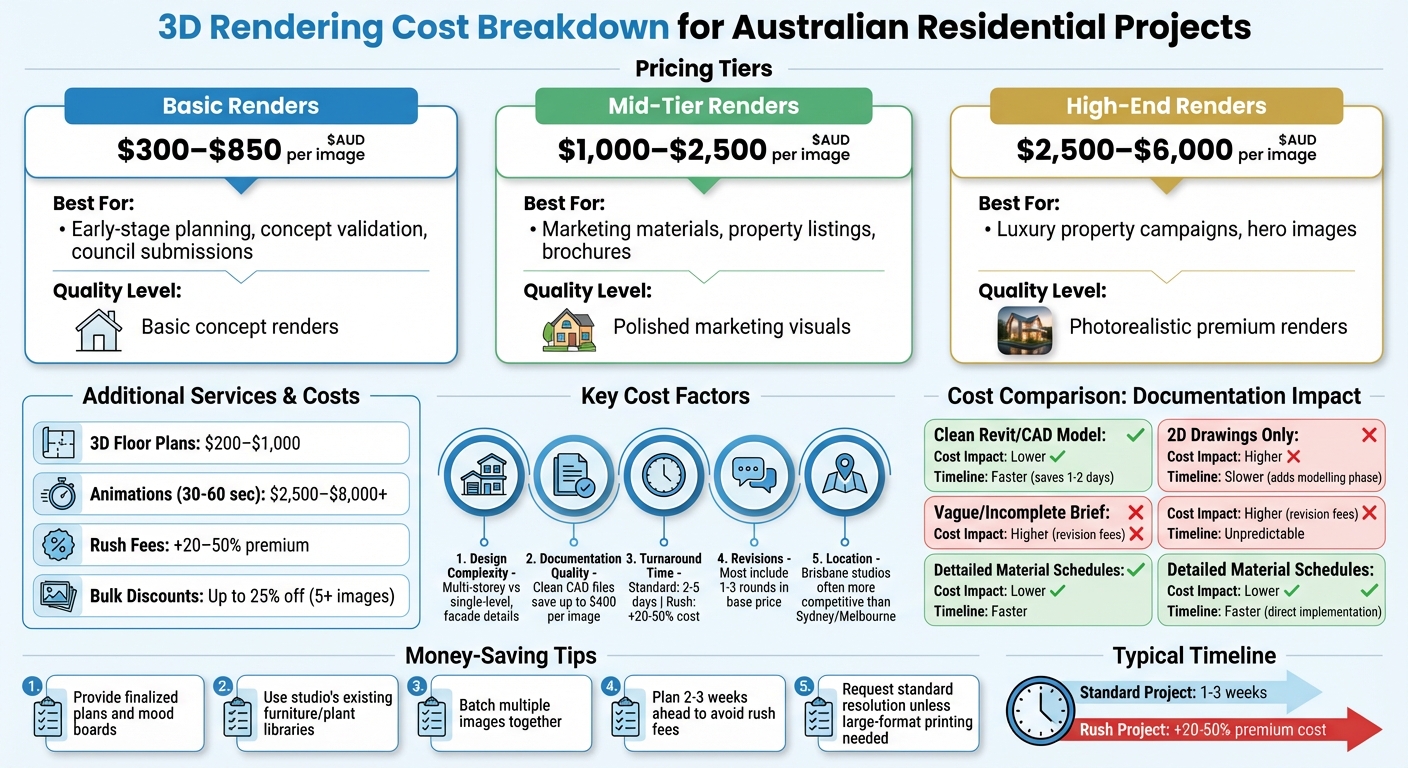
3D rendering in Australia transforms architectural plans into lifelike visuals, helping developers, architects, and homeowners communicate designs effectively before construction. Whether for marketing, council submissions, or client presentations, 3D rendering has become a must-have in residential projects. Here's a quick look at costs and factors to consider:
- Basic Renders: $300–$850 per image for early-stage planning.
- Mid-service levels Renders: $1,000–$2,500 per image for polished marketing visuals.
- High-End Renders: $2,500–$6,000 per image for luxury property campaigns.
- Extras: 3D floor plans ($200–$1,000), animations ($2,500+), and rush fees (20–50% premium).
Costs depend on project complexity, turnaround times, and the quality of documentation provided. For example, clean CAD files can save up to $400 per image, while expedited deadlines increase costs. Studios often include 1–3 revisions in their base price, and bulk discounts (substantially) apply for multiple images.
Planning ahead, finalising designs, and batching renders can help reduce expenses while achieving your project's goals.
How To Price 3D Rendering (Masterclass)
Australian Market Rates for Residential 3D Rendering
When planning a residential rendering project, understanding market rates is essential. These pricing guidelines help developers and homeowners allocate budgets and make informed decisions about their visual marketing needs.
Interior and Exterior Rendering Costs
In Australia, residential 3D rendering costs vary depending on the quality and purpose of the render. Basic concept renders, often used for early-stage planning, cost between $300 and $850 per image. These are ideal for validating initial ideas without breaking the bank.
For marketing purposes, mid-service levels renders are the go-to choice. These typically range from $1,000 to $2,500 per image and are polished enough for property listings and brochures. At the higher end of the spectrum, luxury photorealistic renders cost $2,500 to $4,000, while premium "hero" images - used in high-profile campaigns - can go as high as $4,000 to $6,000 per image.
Interior renders generally fall between $300 and $2,500, with costs influenced by factors like furniture styling and lighting complexity. Exterior renders, on the other hand, range from $300 to $4,000, depending on the building's scale, landscaping, and surrounding urban environment. Additional services, such as 3D floor plans, are priced between $200 and $1,000, while short fly-through animations (30–60 seconds) can cost anywhere from $2,500 to $8,000 or more. These price ranges are shaped by several factors, which are outlined below.
What Affects Price Differences
Several factors influence the cost of 3D rendering. The most significant is time investment. For example, creating a standard exterior render of a modern apartment building typically requires 15 to 24 hours of work. The size and complexity of the project also play a big role - rendering a single-storey home is less expensive than working on a multi-storey building with intricate facades.
The quality of the provided documentation directly impacts the workload. Clean and organised files, such as Revit or CAD formats, streamline the process, while 2D drawings or unorganised plans can increase modelling time and costs. Turnaround speed is another factor; expedited deadlines can add a 20% to 50% premium to the base price.
Location also affects pricing. Studios in Brisbane, for instance, often have more competitive rates than those in Sydney or Melbourne, thanks to lower operating costs. Most studios include one to three revision cycles in their base price, so consolidating feedback into fewer rounds can help avoid extra hourly charges. Additionally, bulk service options (e.g., five or more images) often come with a 10% discount, as the 3D model only needs to be built once.
Main Cost Factors in Residential 3D Rendering
Knowing what influences rendering costs can help you make better budgeting decisions. The final price isn’t random - it’s determined by specific aspects of your project that impact the time and effort involved.
Design Complexity and Detail Requirements
The complexity of your design plays a big role in costs. Multi-storey buildings with intricate facades, detailed glazing, and customised architectural features demand significantly more modelling time compared to simpler, single-level homes. For instance, creating an exterior render of a modern apartment block can take many hours. Adding elements like challenging terrain, precise landscaping, or custom furniture rather than standard library assets further increases the workload.
Lighting setups also affect pricing. Advanced options, such as dusk or night scenes, require additional testing and adjustments, which can drive up costs. As Render Vision explains:
"The more testing and tweaking of a project to get the best quality images and make sure the lighting is perfect… increases the price of the 3d rendering." – Render Vision
This is why a basic concept render might cost $700, while a high-quality hero image could reach $3,500. While the latter is more expensive, it often pays off with faster pre-sales. Beyond design complexity, factors like deadlines and provider expertise also influence costs.
Delivery Speed and Provider Experience
Apart from the design, tight timelines and the skill level of your provider can significantly impact the price. Rush projects come with a premium because they require extra resources to meet deadlines. Typically, a single rendering takes 2–5 days depending on the quality level, so planning ahead can help you avoid these additional fees.
"If you require a quick turnaround for your 3D rendering, be prepared to pay a premium. Rushing a project requires more resources to meet the deadline." – Laurent Visuals
The experience of your rendering provider also matters. Established studios with a strong track record often charge more but deliver better project management, fewer revisions, and higher accuracy. While highly skilled artists demand higher day rates, their expertise often translates into a stronger return on investment.
How Client Documentation Affects Costs
The quality of your documentation is another key factor in managing costs. Detailed and organised submissions can reduce the number of revisions required, ultimately saving both time and money. For example, providing clean Revit or CAD models can cut costs by as much as $400 per image compared to starting from scratch. Comprehensive documentation, including material schedules, elevations, sections, and supplier references, eliminates guesswork and speeds up the process.
"Complete, organised plans, schedules and references cut guesswork and revisions." – Nathan Battishall
Most studios include 1–2 rounds of revisions in their base price. However, vague briefs or incomplete plans often lead to extra revisions, which are typically billed at hourly rates. To stay within budget, it’s a good idea to finalise your design before rendering starts and consolidate your feedback into clear, batch notes.
The table below highlights how the quality of your documentation impacts both costs and timelines:
Documentation Provided Impact on Cost Impact on Timeline
Clean Revit/CAD Model Lower (reduces modelling hours) Faster (saves 1–2 days)
2D Drawings Only Higher (requires manual 3D build) Slower (adds a modelling phase)
Vague/Incomplete Brief Higher (increases revision fees) Unpredictable (due to rework)
Detailed Material/FF&E Schedules Lower (reduces trial-and-error) Faster (direct implementation)
sbb-itb-1b6d2bc
Pricing Models and Payment Options
Australian rendering studios generally follow three pricing structures. Knowing how these models work can help you choose the right one for your project and avoid unexpected expenses.
Hourly Rates vs Per-Image Pricing
Per-image pricing is the go-to option for most residential projects in Australia. With this model, you pay a fixed fee for each rendered view, making it easier to plan your budget from the outset. This approach works best when your project has clear plans and specific views in mind. However, any changes to the scope will usually result in additional revision charges.
On the other hand, hourly rates provide flexibility but can make budgeting trickier. Rates typically range from $25 to $100 per hour, depending on the studio’s expertise and location. This model is ideal for projects that are still in the early design stages, where you may need to experiment with different ideas. The downside? Costs are tied to the total hours worked, which makes it harder to predict the final bill.
"Per-image pricing is predictable, easy to budget, and works well for projects with well-defined scopes." – Lukas Berezowiec, Founder, NoTriangle Studio
Here’s a quick comparison of these two pricing models:
Feature Per-Image Pricing Hourly Rate Pricing
Best For Fixed scopes with finalised plans Evolving designs and early concepts
Predictability High; costs are clear upfront Low; depends on time spent
Flexibility Limited; changes incur extra fees High; allows ongoing adjustments
Common Use Marketing materials and DA submissions Early-stage design development
These models provide a foundation for understanding how service options deals can further optimise costs for residential projects.
service options Deals for Residential Projects
For multi-unit developments, such as duplexes or townhouses, service options pricing is a cost-effective option. This model bundles several images into a single fixed price, significantly reducing costs as the 3D model is only created once. Many Australian studios offer discounts of about 10% for orders of five or more images, with some service options cutting per-image costs by substantially.
This approach works best when you can determine all the required views upfront. For instance, a marketing service options for a duplex might include four to six images - such as a hero exterior, rear view, and key interior spaces - priced between $5,000 and $15,000. Most service options also include one to three rounds of revisions. To get the most out of these deals, ensure you provide all necessary documentation, like floor plans, elevations, and material references, before the work begins.
How to Plan Your 3D Rendering Budget
Calculating Costs for Your Project
When planning your 3D rendering budget, start by narrowing down your project's purpose and quality needs. For instance, if you only need basic concept images for approvals, expect to spend between $300 and $850 per render. On the other hand, marketing visuals designed to impress can range from $1,000 to $4,000 per image.
Next, think about the complexity of your design. A simple single-storey home will cost less than a multi-storey property with intricate facades or detailed landscaping. The number of views you need also impacts the cost - multiple angles can reduce the per-image price since the same base model is reused. Additionally, providing clean CAD or Revit files can significantly cut down modelling time, saving you money.
Keep in mind that most standard projects take one to three weeks to complete. If you're in a rush, you might face an extra 20–50% premium for expedited work. Lastly, consider the quality service levels you want. As Nathan Battishall points out:
"Choosing a $3,500 hero over a $700 basic render is a $2,800 difference - often recouped if you bring pre-sales forward or nudge contract values even slightly".
Ways to Reduce Rendering Costs
Once you've estimated your budget, there are a few ways to keep costs down without sacrificing quality. Start by providing finalised plans and mood boards - this reduces revisions and saves money. If possible, opt for a studio's pre-existing library of furniture and plants instead of requesting custom 3D models.
Batching your images is another smart move. Studios often offer bulk discounts, and consolidating feedback through a single contact can streamline the process. Timing also matters - begin your project two to three weeks in advance to avoid rush fees. Lastly, only request high-resolution images (like 4K or 6K) when they're absolutely necessary for large-format printing. For web or brochure use, standard resolutions are usually sufficient and more affordable.
Conclusion
Understanding the costs of 3D rendering is crucial for residential projects in Australia. Prices typically fall between $300 and $6,000 per image, influenced by factors such as design complexity, required photorealism, and turnaround time. The trick is aligning your budget with the project's goals - basic renders work well for council submissions, while investing in high-quality hero images pays off when marketing luxury properties. This pricing guide underscores the importance of tailored budgeting for successful project outcomes.
You can manage costs effectively with proper preparation. For instance, providing clean CAD or Revit files, finalising your design early, and grouping multiple images for rendering can help lower your expenses. Most standard residential projects take between one to three weeks, so planning ahead to avoid rush fees - which can add 20–50% - is a smart move.
Ultimately, the focus shouldn’t just be on finding the cheapest option but on getting the best value for your investment. As Laurent Visuals aptly puts it:
…continued on the original article.