

Selling apartments before construction in Australia can be challenging. Buyers are hesitant to invest significant amounts based solely on technical drawings. That’s where 3D apartment renders make a difference. These photorealistic visuals transform floor plans into lifelike representations, showcasing layouts, finishes, and even natural lighting. They help buyers visualise their future homes, boosting confidence and emotional connection.
Key benefits include:
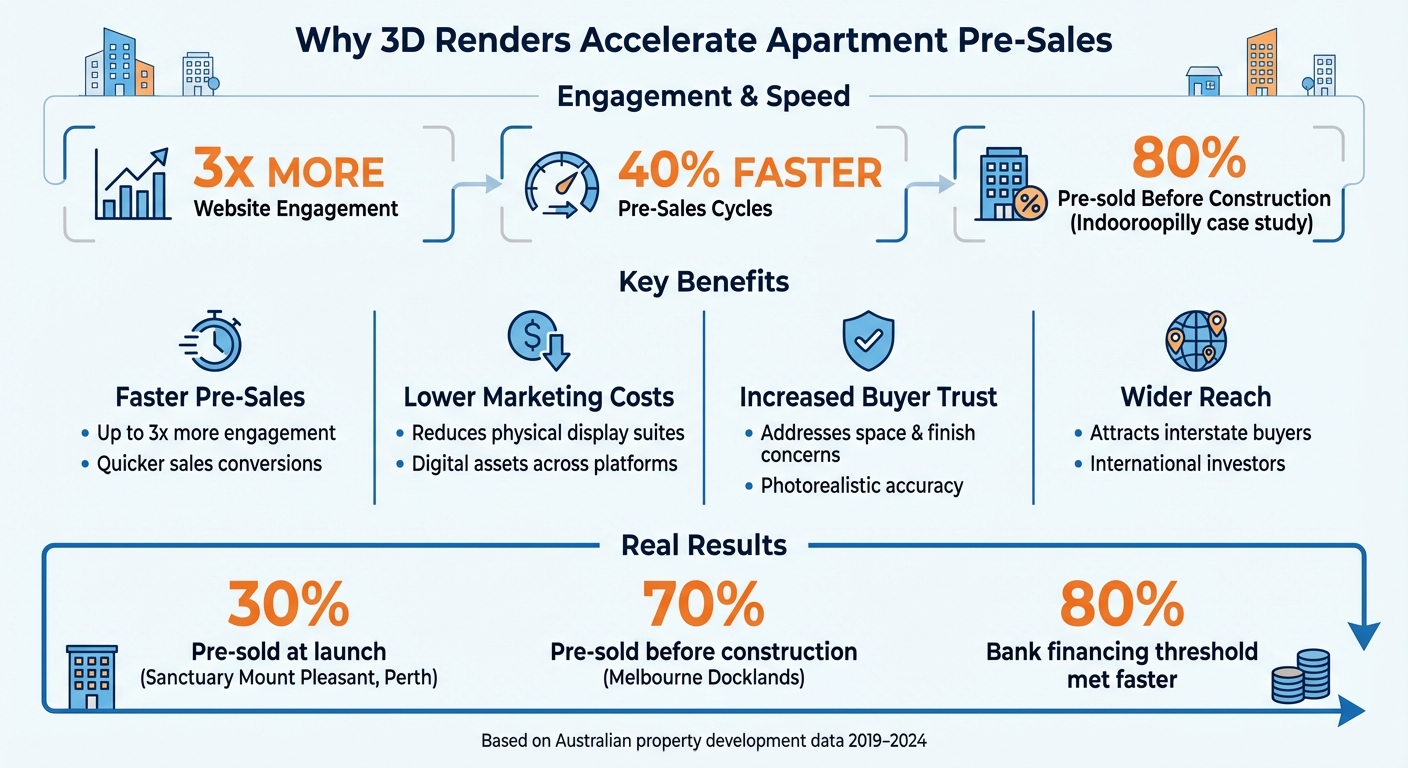
- Faster Pre-Sales: Listings with 3D visuals see up to significantly more engagement, often leading to quicker sales.
- Lower Marketing Costs: Digital renders reduce reliance on expensive physical display suites.
- Increased Buyer Trust: High-quality visuals address concerns about space, size, and finishes.
- Wider Reach: Virtual walkthroughs attract interstate and international buyers.
Developers using 3D renders have reported up to notably faster pre-sales and improved financing opportunities. By providing clarity and reducing uncertainty, these tools are reshaping how properties are marketed and sold in Australia.
The 7 Step Formula to Photorealistic Interior 3D Renders
Problems with Selling Apartments Off-the-Plan in Australia
Selling apartments before they're built is no small feat. Buyers are asked to commit hundreds of thousands - or even millions - of dollars based solely on plans and promises. It's no wonder traditional approaches often fall short. Here’s a closer look at the challenges and why advanced 3D visual tools are becoming a game-changer.
Why 2D Plans Fall Short for Buyers
Floor plans and blueprints might work for architects, but for buyers? Not so much. These static visuals fail to convey how a space will feel or function. Buyers struggle to imagine how rooms connect, how light flows through the space, or whether their furniture will fit. This lack of clarity often leads to confusion and disengagement. And without a clear vision of the finished product, buyers are unlikely to form that crucial emotional connection - one that justifies such a major financial decision.
As Tim Brickle from 3D Walkabout puts it:
"No one is going to click on a floor plan".
Building Trust in Unbuilt Properties
Trust is everything when it comes to buying off-the-plan. Buyers are essentially putting their faith in a promise - a promise that the final property will live up to their expectations. But as Apartments.com.au Editorial notes:
"Buying off‐the‐plan has customarily been, in part, a stab in the dark".
Traditional marketing tools, like display suites showcasing a single room or isolated samples of colour swatches, fail to provide the full picture. Even small inaccuracies, such as a door that looks too wide or a ceiling that seems lower than expected, can erode confidence. And in a competitive property market, any loss of trust can be costly.
Standing Out in Australia's Overcrowded Property Market
In cities across Australia, new developments are constantly being launched, making it harder than ever for any single project to stand out. Basic brochures and static 2D plans simply don’t cut it anymore. Today’s buyers expect more - they want to step into the property virtually, explore the surrounding neighbourhood, and see how the space aligns with their lifestyle aspirations.
Static marketing tools risk being overshadowed by competitors offering immersive 3D walkthroughs and photorealistic renders that bring properties to life. Developers who fail to embrace these tools may find themselves left behind in an increasingly digital and visually driven market.
How 3D Apartment Renders Improve Pre-Sales Results
Switching from traditional marketing to 3D visualisation isn’t just about making things look better - it solves real challenges that often slow down off-the-plan sales. When buyers can clearly see what they’re investing in, they feel more confident about their decisions.
Better Visualisation Increases Buyer Interest
Listings that include 3D visuals get three times more website engagement compared to those with static images alone. Why? Because 3D visuals turn technical floor plans and drawings into spaces that buyers can immediately understand and connect with.
Take the example of a mid-service levels Indooroopilly developer. By using exterior renders and virtual staging, they sold 80% of their units before construction even began. These renders didn’t just show the structure - they incorporated lifestyle elements like subtropical landscaping and carefully chosen furniture, making it easier for buyers to picture themselves living there.
3D renders go beyond just showing a layout. They provide a clear sense of room flow, how natural light interacts with the space, and the overall design. This eliminates the need for buyers to imagine what the space might feel like, making the process effortless and emotionally engaging.
Building Buyer Confidence Before Construction Starts
High-quality 3D renders take the uncertainty out of buying off-the-plan by showing exactly what buyers will get - right down to the texture of the flooring or the details of the kitchen fixtures. This level of clarity can turn casual interest into firm commitments.
A great example is Siera Group’s Tapestry development on Chevron Island in 2023. When buyers had recurring concerns about the size and views of a particular unit type, the developer created a photorealistic walkthrough to address these issues. Brent Thompson, Principal Director at Siera Group, explained:
"When buyers were asking the same questions about a specific unit type, Volume Vision was able to quickly create a photorealistic walkthrough of the space to help overcome queries about size and view lines, helping our team secure multiple sales".
Technology like raytracing plays a big role here, simulating light to create soft shadows and realistic reflections. By rendering every aspect - doors, hallways, and more - at an accurate real-world scale, buyers are more likely to trust what they see.
As AX2 Studio points out:
"3D rendering allows you to successfully market your development to both buyers and financial lenders, helping them to share your vision and achieve your goals".
This is especially critical in Australia, where developers often need to sell 80% of apartments off-the-plan to secure construction financing from banks. By building both trust and excitement, 3D renders not only boost sales but also reduce the time and cost of marketing, as we’ll explore next.
Selling Faster and Spending Less on Marketing
The clarity and trust built by 3D renders translate directly into faster pre-sales and lower marketing costs. Developers using these assets report pre-sales cycles that are up to notably faster. Faster sales mean financing can be secured sooner, allowing construction to start without delays.
The financial benefits don’t stop there. High-quality 3D renders and virtual walkthroughs eliminate the need for costly physical display suites. Instead of pouring money into building and maintaining showrooms, developers can use digital assets across multiple platforms - websites, social media, brochures, and even billboards.
One standout example is a luxury apartment project in South Bank. By using VR property tours, the development attracted international buyers from places like Singapore and Hong Kong, who confidently purchased units without ever visiting in person. This "sight unseen" capability opens the door to interstate and overseas investors, expanding the buyer pool significantly.
Another advantage of digital renders is their flexibility. If market feedback suggests a shift in buyer preferences - say, from luxury finishes to a minimalist design - developers can update the virtual staging quickly and affordably, avoiding the expense of physical changes.
Tim Brickle sums it up perfectly:
"The main reason to sell off the plan is it's a way to manage risk and check that there's demand while commitment is still low".
With 3D renders, developers can test market demand and secure sales early, all while keeping financial risks low. It’s a faster, smarter, and more cost-effective approach compared to traditional methods.
Types of 3D Renders for Apartment Pre-Sales
When it comes to marketing off-the-plan apartments, developers rely on three main types of 3D renders. Each serves a unique purpose, catering to different buyer interests and helping to establish trust and appeal.
Exterior Renders: Highlighting Building Design and Surroundings
Exterior renders are all about showcasing the building's facade, architectural design, and its connection to the surrounding environment. These visuals often serve as the first impression in marketing campaigns, making them a crucial tool for grabbing attention.
By incorporating local features - like streetscapes, parks, or landmarks - exterior renders can emphasise the appeal of a development's location. For instance, a project near Brisbane's South Bank might include views of the Brisbane River or the city skyline to highlight its lifestyle advantages. Developers also use these renders for council approvals and planning submissions, as they provide an accurate depiction of materials, landscaping, and neighbouring buildings. Twilight or dusk renders are particularly favoured in marketing because they evoke a warm, luxurious atmosphere.
Interior Renders: Bringing Layouts and Finishes to Life
While exterior renders focus on the big picture, interior renders zoom in on the living experience. These visuals highlight room layouts, material finishes like stone benchtops or timber floors, and furniture arrangements, helping potential buyers picture themselves in the space.
Interior renders are essential for communicating lifestyle and quality. They capture details like textures and finishes with striking clarity. Virtual staging adds another layer of flexibility, allowing spaces to be digitally furnished in various styles to appeal to different buyer groups - all without the costs of physical staging.
Virtual Walkthroughs: Immersive Remote Property Viewing
Virtual walkthroughs take the concept of 3D renders to the next level, offering buyers the chance to explore a property from anywhere. These can be presented as guided 3D animations or interactive 360-degree tours.
Tim Brickle from 3D Walkabout sums up their value perfectly:
"3D animations are emerging as a useful tool to get off-plan developments on the market and sell fast. They present homes in their finished state even before construction's begun".
sbb-itb-1b6d2bc
Using Laurent Visuals for Your Pre-Sales Campaign
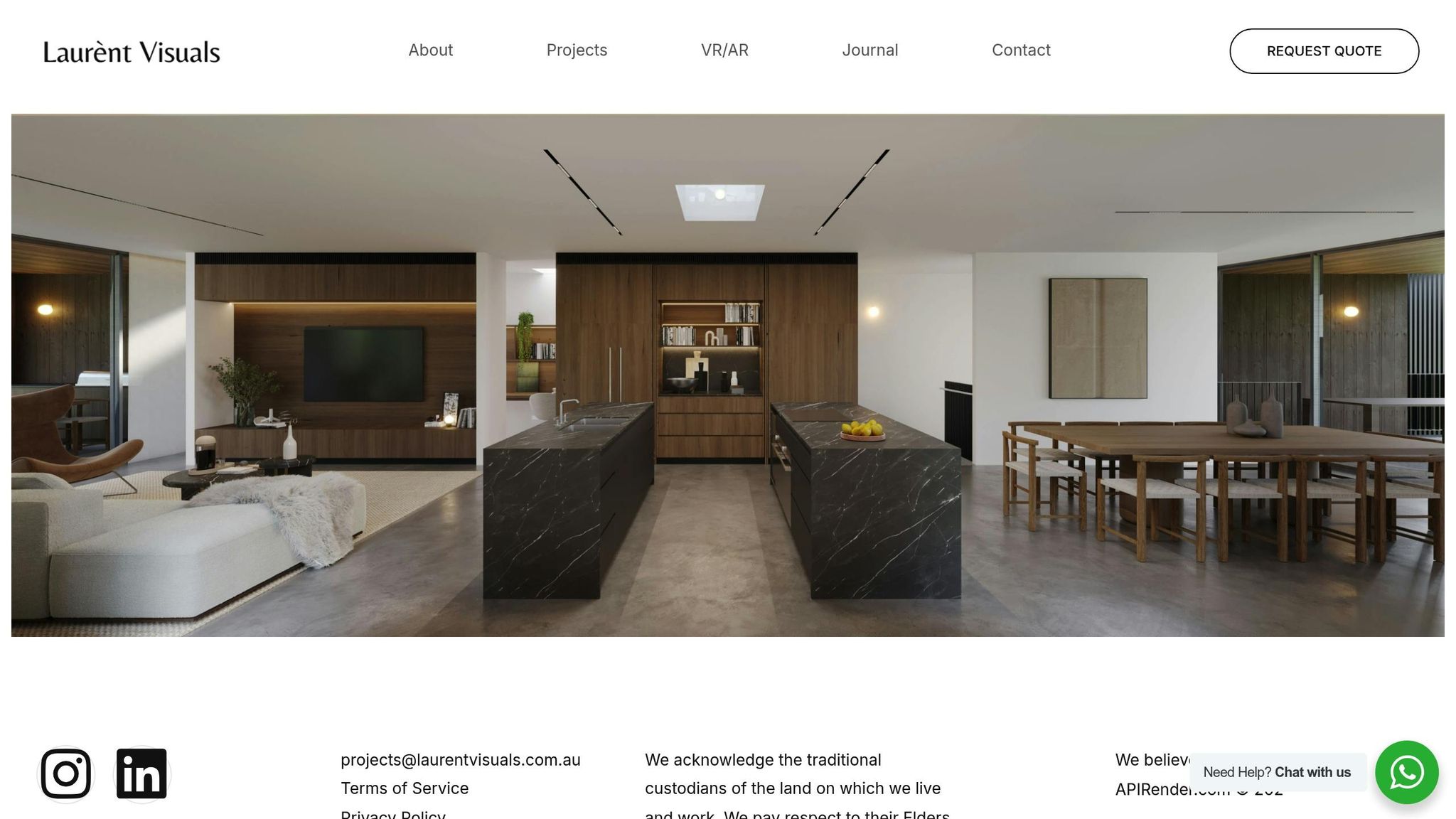
Laurent Visuals, based in Brisbane, brings together a team of 3D artists who are also trained architects and project managers. With expertise in Australian property marketing and development, they cater to developers across Australia and New Zealand aiming to pre-sell with confidence. The studio combines technical know-how in architectural documentation with a deep understanding of the commercial aspects of off-the-plan sales. All this comes with the added benefit of regional pricing advantages, without any compromise on quality.
Laurent Visuals Service Plans and What They Include
Laurent Visuals offers three distinct service service levels tailored to meet the needs of pre-sales campaigns:
Service Category Features & Pre-Sales Applications
Conceptual Renders Ideal for showcasing initial design intent, securing funding, and gathering early-stage stakeholder feedback.
Photorealistic Marketing Visuals High-resolution interior and exterior images designed for brochures, social media, and off-the-plan sales campaigns.
Immersive Solutions Interactive Virtual Reality (VR) experiences and architectural animations to deepen buyer engagement and connection.
The cost of standard 3D renders ranges from $750 to $5,000 AUD per visual, depending on their complexity. For more interactive experiences, 3D virtual tours start at $350 AUD. Additionally, the studio provides dedicated project websites that consolidate renders, brochures, and floor plans, helping developers drive more enquiries.
In late 2024, Laurent Visuals created stunning 3D renders for a coastal residential project in Birkdale. These renders highlighted the light and texture of both single and double-storey residences, which are set to begin construction in Q1 2026.
Next, let’s explore how Laurent Visuals brings these renders to life through a carefully structured process.
How the Rendering Process Works
Once you’ve chosen a service service levels, Laurent Visuals follows a detailed process to transform design documents into visually compelling 3D renders. Here’s how it works:
Step Phase Description
1 Documentation Clients securely upload drawings and materials for the project.
2 Briefing Specific camera angles are selected and approved by the client to ensure the renders capture key features.
3 Greyscale Preview Initial previews focus on layout and structure, omitting finishes to allow for structural evaluation.
4 Colour Previews Realistic lighting, textures, finishes, and fixtures are applied to bring the render closer to its final look.
…continued on the original article.